New to LastDodo?See how it works
New here? LastDodo is rated
99.2% positive in 723,943 shop reviews. Find out how it works
BuySellCatalogueCollection Wish list Forum
EN
NederlandsEnglishFrançaisDeutsch
Shopping cart of:
You have more shopping carts
View 10 shopping carts from other shops
Shopping cart

The shopping cart is currently empty.

Sign inFrequently Asked Questions
Sign in
StampsComic booksCoinsBooksMusicFilmPostcardsTrading cardsCigar bandsModel carsTea bags
All areas (75)
All areas
  • A
  • Album pictures(145,138)
  • Alcohol / beverages(8,186)
  • Audiovisual equipment(1,225)
  • Autographs(5,545)
  • B
  • Badges(4,475)
  • Banknotes(30,261)
  • Beer labels(83,168)
  • Beer mats(149,921)
  • Board games(19,085)
  • Bookmarks(3,891)
  • Books(493,979)
  • C
  • Calculators(1,702)
  • Cans / tins(9,661)
  • Caps and Pogs(19,972)
  • Car brochures(10,726)
  • Ceramics(5,586)
  • Cigar labels(291,888)
  • Clocks and alarm clocks(627)
  • Coins(104,892)
  • Collection albums(5,348)
  • Comic books(657,809)
  • Comic ex-libris and prints(43,490)
  • Creamer cup lids(24,241)
  • Crown Caps(8,942)
  • D
  • Dolls and bears(3,583)
  • Drawings / paintings(30,989)
  • DVD / Video / Blu-ray(95,892)
  • E
  • Enamel signs(832)
  • Entrance tickets(3,252)
  • F
  • Figures and statuettes(92,312)
  • Fossils(331)
  • G
  • Gift cards(27,293)
  • J
  • Jewellery(3,161)
  • Jigsaw puzzles(8,022)
  • K
  • Keychains(9,412)
  • Kitchenware & tableware(19,863)
  • L
  • Lighters(6,772)
  • M
  • Magazines / newspapers(291,568)
  • Maps and globes(3,013)
  • Markclips(33,750)
  • Match Programmes(5,702)
  • Matchcovers(101,293)
  • Minicards(18,845)
  • Model cars and scale model(81,778)
  • Model trains / Railway modelling(12,473)
  • N
  • Naturalia(7,787)
  • P
  • Perfins(13,499)
  • Perfume bottles(9,024)
  • Phone cards(112,662)
  • Photo and video cameras(5,855)
  • Picture stamps(8,728)
  • Pins and buttons(102,380)
  • Postcards(426,828)
  • Posters(11,363)
  • Prints / graphics(5,925)
  • R
  • Records and CDs(260,772)
  • Revenue stamps(6,324)
  • Rolling papers(3,738)
  • S
  • Securities and bonds(1,550)
  • Stamps(966,231)
  • Stationery(4,125)
  • Stickers(35,533)
  • Sugar sachets(64,389)
  • T
  • Tea bags(154,517)
  • Telephones(270)
  • Templates and molds(3,819)
  • Thimbles(2,706)
  • Tokens / Medals(24,302)
  • Toy soldiers(20,213)
  • Toys(14,260)
  • Trading cards(251,982)
  • V
  • Vases & flowerpots(3,519)
  • Video games(22,187)
  • W
  • Watches(3,135)
  • Wine(2,681)
  1. Home
  2. Catalogue
  3. Books
  4. Series / protagonists
  5. Moby Dick
BooksRelated areas (1)

Moby Dick books catalogue

46 items

Moby Dick or the White Whale. The book was written in 1850 by Herman Melville (1891-1891). Initially maligned by critics, it was rediscovered around 1920. It has now become a classic of undisputed epic proportions.  More

Moby Dick

Moby Dick

LOOMINGS
'Call me Ishmael. Some years ago –– never mind how long precisely –– having little or no money in my purse, and nothing particular to interest me on shore, I thought I would sail about a little and see the watery parts of the world'.

WORRIES
Thus begins the story of the narrator ('Just Call Me Ishmael') who, having nothing better to do and little money, sets out on an adventure and signs up on a whaling ship to explore the uncharted waters of the world.

INN "DE SPUITER"
In December, Ishmael travels on foot from Manhattan Island to New Bedford, Massachusetts. The inn he stays at is overcrowded. If he wants to spend the night, he has to share a bed with a stranger. It's already very late at night, and his roommate hasn't shown up yet. As Ishmael lies in bed in the dark, the door finally opens. A large, shadowy figure enters. Without noticing Ishmael, he lights a fire, places an idol in front of it, and then begins performing a strange ritual.

A BOOST FRIEND
The unknown roommate turns out to be the tattooed Polynesian and cannibal Queequeg, a skilled harpooner whose father was the king of the island of Rokovoko. Ishmael and Queequeg will become great friends.

THE SERMON
The next morning, Ishmael and Queequeg attend a sermon by Father Mapple about Jonah and then travel to the offshore island of Nantucket. There, they sign up with a Quaker shipowner for a voyage on the whaling ship Pequod. The shipowner describes the captain, Ahab: "He is a great, godless, godly man, yet 'human.'" On the way to the ship, a man named Elijah predicts a terrible fate awaits them if they join Ahab. While provisions are being loaded, they board the ship anyway. On a cold Christmas Day, the Pequod leaves port.

AHAB
During a voyage seven years ago, a mysterious White Whale had torn off Captain Ahab's leg and he is therefore obsessed with the idea that he must kill this whale at all costs.

THE PEQUAD
Now the crew of the Pequod begins an endless pursuit, marked by many perilous adventures and terrible accidents. They must follow the monomaniacal Ahab, with his insatiable thirst for vengeance, to the inevitable abyss.

THE GLORY OF WHALING
At first glance, Moby-Dick is a lively documentary about life aboard a nineteenth-century whaling ship, a virtual encyclopedia of whales and whaling, packed with facts, legends, and trivia gleaned from Melville's personal experience and numerous sources.

MOBY DICK
But as the search for the whale becomes increasingly prolonged and unbearable, the story operates on an allegorical level, comparing whale hunting to human greed and the moral consequences of their actions and the difference between right and wrong.
Who's good? – The great white whale who, like nature, asks nothing more than to be left alone? Or the bold Ahab who, like scientists, explorers, and philosophers, fearlessly seeks to unravel the mysteries of the universe?
Who is evil? – The ferocious, man-killing sea monster? Or the obsessed Captain Ahab, who risks the lives of his entire crew in his quest to slay the beast for his personal revenge?

BIOGRAPHICAL
Melville set sail on January 3, 1841, aboard the whaler Acushnet for a voyage that would last nearly six months. He and about twenty others slept in the forecastle; Captain Valentine Pease, the mates, and the able men slept aft.
On April 15, the Acushnet rounded Cape Horn and sailed into the South Pacific, where the crew sighted whales but caught none. They then proceeded along the coast of Chile to the region of Selkirk Island (the inspiration for the novel Robinson Crusoe). Other whalers were also in the area the Acushnet was sailing, and they would sometimes visit each other. Melville thus met William Henry Chase, son of Owen Chase, on the Lima from Nantucket, who gave him a copy of his father's account of his adventures aboard the Essex. Ten years later, Melville wrote in his copy of the book: "The reading of this wonderful narrative on the landless sea, and near the latitude of the wreck, had a surprising effect on me."

THE ESSEX
The Essex had departed Nantucket on August 12, 1820, for a whaling voyage. Of the 21 crew members, only nine returned.
After rounding Cape Horn on November 20th, the Essex, near the equator, 1,000 miles west of the Galapagos Islands, sighted a pod of sperm whales. Three boats were deployed. A harpooned sperm whale punched a hole in one of the rowboats with its tail, and the line was cut. The enraged sperm whale, with the harpoon still lodged in its body, then attacked the whaling ship Essex. With two powerful headbutts, it sank it.
The incident had taken place far from land. After nearly three months in the rowboats, a few survivors were rescued. They had only been able to endure this long because they had resorted to cannibalism.

MOCHA DICK
This sperm whale might have been 'Mocha Dick'.
Mocha Dick (died 1838) was a male sperm whale that lived in the Pacific Ocean in the early 1800s and was usually found in the waters near Mocha Island, off the coast of Chile. American explorer and author Jeremiah N. Reynolds published his account, "Mocha Dick: Or The White Whale of the Pacific: A Leaf from a Manuscript Journal," in 1839. Mocha Dick was an albino sperm whale. He survived many skirmishes (at least 100, according to Reynolds) with whaling ships before being killed. He was large and powerful, capable of destroying small vessels with his tail.

MELVILLE
On September 25, 1841, Melville's ship reported 600 barrels of oil to another whaler, and in October, 700 barrels. On December 27, the Acushnet was off Cape Blanco, off the coast of Ecuador. In early January 1842, the ship approached the Galapagos Islands from the southeast. From February 13 to May 7, seven sperm whale sightings were recorded, but none were killed. From early May to early June, the Acushnet continued hunting in conjunction with the Columbus of New Bedford, which also accepted letters from Melville's ship as it returned home. On June 23, 1842, the Acushnet reached the Marquesas Islands and anchored at Nuku Hiva.

TYPEE and OMOO
Fed up with the hardships of life, Melville and his shipmate Richard Tobias Greene ("Toby") jumped ship in the bay of Nuku Hiva. Melville's first book, Typee (1846), is based on his time in the Taipi Valley. By mid-August, Melville had left the island aboard the Australian whaler Lucy Ann, bound for Tahiti, where he participated in a mutiny and was briefly imprisoned. In October, he escaped from Tahiti to Eimeo ("Omoo" in Tahitian). He then spent a month as a beachcomber, eventually crossing to Moorea.
He used these experiences for his book "Omoo," the sequel to "Typee." In November, he received a contract as a seaman on the Nantucket whaler Charles & Henry for a six-month cruise (November 1842–April 1843), and was discharged in May 1843 at Lahaina, Maui, in the Hawaiian Islands.

THE BOOK
Melville began writing Moby-Dick in February 1850 and finished it 18 months later. He drew on his experience as a common seaman from 1841 to 1844, including service on whaling ships, and his extensive reading of whaling literature. The White Whale is based on Mocha Dick, and the book's ending is based on the sinking of the whaleship Essex in 1820. With detailed and realistic descriptions of whaling and whale oil extraction, as well as life aboard a culturally diverse crew, it is interwoven with explorations of class and social status, good and evil, and the existence of God.

EPILOGUE
The book was first published (in three parts) as The Whale in London in October 1851, and under its final title, "Moby Dick or The Whale," as a single volume in New York in late November. London publisher Richard Bentley censored or altered sensitive passages and omitted the Epilogue; Melville also made changes, including a last-minute title change for the New York edition. Reviewers in Britain were largely positive, although some objected that the story seemed to be told by a narrator who perished with the ship, as the British edition omitted the epilogue recounting Ishmael's survival. American reviewers were even more hostile. They also found the short chapter arrangement unliterary.

Yet Melville's masterpiece has survived the initial misconception and become an American classic of undisputed epic proportions.

ROCKWELL KENT
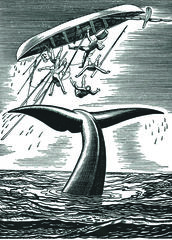
The 1930 edition, illustrated by Rockwell Kent, published by Lakeside Press and Random House is considered the finest edition, with nearly 300 beautiful illustrations and a very fitting text design. At first glance, the illustrations resemble woodcuts, but they are not. They are drawn with brush, pen, and ink on paper.

Automatic translation Click here for the original text
Hide original text

LOOMINGS

‘Call me Ishmael. Some years ago –– never mind how long precisely –– having little or no money in my purse, and nothing particular to interest me on shore, I thought I would sail about a little and see the watery parts of the world’.

BESLOMMERINGEN

Zo begint het verhaal van de verteller (‘Noem mij maar Ishmael’) die, omdat hij niets beters te doen heeft en ook weinig geld, op avontuur gaat en aanmonstert op een walvisvaarder om de onbekende wateren van wereld te verkennen.

HERBERG “DE SPUITER”

Ismaël reist in december, te voet, van Manhattan Island naar New Bedford, Massachusetts. De herberg waar hij intrekt is overvol. Als hij wil overnachten moet hij een bed delen met een vreemde. Het is al heel laat in de nacht en zijn kamergenoot is nog niet komen opdagen. Als Ishmael in het donker in bed ligt gaat uiteindelijk de deur open. Er komt een grote schimmige figuur binnen. Deze gaat, zonder Ishmael op te merken, een vuurtje aansteken waarvoor hij een afgodsbeeldje plaats en dan een vreemd ritueel begint uit te voeren…

EEN BOEZEMVRIEND

De onbekende kamergenoot blijkt de getatoeëerde Polynesiër en kannibaal Queequeg te zijn, een kundig harpoenier wiens vader koning was van het eiland Rokovoko. Ishmael en Queequeg zullen grote vrienden worden.

DE PREEK

De volgende ochtend wonen Ismaël en Queequeg een preek bij van pater Mapple over Jonas en gaan vervolgens naar het, voor de kust gelegen, eiland Nantucket. Daar schrijven ze zich in bij een Quaker-reder voor een reis met de walvisvaarder Pequod. De reder beschrijft de kapitein, Ahab: "Hij is een grootse, goddeloze, goddelijke man die niettemin “menselijk” is”. Op weg naar het schip voorspeld een man genaamd Elia dat hen een verschrikkelijk lot te wachten staat als zij zich bij Ahab zullen voegen. Terwijl proviand wordt geladen, gaan ze toch aan boord van het schip. Op een koude eerste kerstdag verlaat de Pequod de haven.

AHAB

Tijdens een reis, zeven jaar geleden, had een mysterieuze Witte Walvis het been van kapitein Ahab afgerukt en hij is daarom bezeten van het idee dat hij deze walvis coûte-que-coûte moet doden.

THE PEQUAD

Nu begint de bemanning van de Pequod aan een eindeloze achtervolging die gepaard gaat met vele hachelijke avonturen en verschrikkelijke ongelukken. Zij zullen de monomane Ahab met zijn onstilbare dorst naar wraak naar de onvermijdelijke afgrond moeten volgen.

’DE GLORIE VAN HET WALVISVAREN’

Op het eerste gezicht is Moby-Dick een levendige documentaire over het leven aan boord van een negentiende-eeuwse walvisvaarder, een virtuele encyclopedie van walvissen en de walvisvangst, boordevol feiten, legendes en trivia die Melville uit persoonlijke ervaringen en talloze bronnen had verzameld.

MOBY DICK

Maar naarmate de zoektocht naar de walvis steeds langer duurt en ondraagbaar wordt, werkt het verhaal op een allegorisch niveau, waarbij de jacht op walvis wordt vergeleken met menselijke hebzucht en de morele consequenties van hun handelen en het verschil tussen goed en kwaad.

Wie is goed? – De grote witte walvis die, net als de natuur, niets anders vraagt dan met rust gelaten te worden? Of de stoutmoedige Ahab die, net als wetenschappers, ontdekkingsreizigers en filosofen, onbevreesd de mysteries van het universum wil ontrafelen?

Wie is slecht? – Het woeste, mensen-dodende zeemonster? Of de geobsedeerde Kapitein Ahab die in zijn zoektocht om het beest te doden het leven van zijn hele bemanning op het spel zet vanwege zijn persoonlijke wraak?

BIOGRAFISCH

Melville vertrok op 3 januari 1841 met de walvisvaarder Acushnet voor een reis die bijna zes maanden zou duren. Hij sliep met zo'n twintig anderen in het vooronder; Kapitein Valentine Pease, de stuurlieden en de bekwame mannen sliepen in het achterschip.

Op 15 april rondde de Acushnet Kaap Hoorn en voer naar de Stille Zuidzee, waar de bemanning walvissen zag zonder er één te vangen. Vervolgens ging ze langs de kust van Chili naar de regio van het eiland van Selkirk (Hij was de inspiratiebron voor de roman Robinson Crusoe). In het vaargebied waarin de Acushnet voer bevonden zich ook andere walvisvaarders en soms ging men bij elkaar op bezoek. Melville ontmoette zo William Henry Chase, de zoon van Owen Chase, op de ‘Lima’ uit Nantucket, die hem een kopie gaf van zijn vaders verslag van zijn avonturen aan boord van de Essex. Tien jaar later schreef Melville in zijn exemplaar van het boek: "Het lezen van dit wonderbaarlijke verhaal op de landloze zee, en dicht bij de breedtegraad van het scheepswrak, had een verrassend effect op mij".

DE ESSEX

De Essex was op 12 augustus 1820 vertrokken uit Nantucket voor een walvisvaart. Van de 21 bemanningsleden zouden er maar 9 terugkeren.

Na Kaap Hoorn gerond te hebben kwam de Essex op 20 november in de buurt van de evenaar, 1600 km ten westen van de Galápagos eilanden, kregen ze een school potvissen in de gaten. Drie boten werden uitgezet. Een potvis die geharpoeneerd werd sloeg met zijn staart een gat in één van de roeiboten en men kapte de lijn. De woedende potvis, de harpoen stak nog in zijn lijf, viel daarop het walvischip Essex aan. Met twee geweldige kopstoten bracht hij het tot zinken.

Het voorval had plaatsgehad op een plek ver verwijderd van land. Na bijna drie maanden in de roeiboten te hebben doorgebracht werden enkele overlevenden gered. Zij hadden het alleen zolang kunnen uithouden doordat ze tot kannibalisme waren overgegaan.

MOCHA DICK

Deze potvis zou ‘Mocha Dick’ geweest kunnen zijn.

Mocha Dick; (overleden in 1838) was een mannelijke potvis die begin 19e eeuw in de Stille Oceaan leefde en meestal werd aangetroffen in de wateren nabij Mocha Island, voor de kust van Chili. De Amerikaanse ontdekkingsreiziger en auteur Jeremiah N. Reynolds publiceerde zijn verslag "Mocha Dick: Or The White Whale of the Pacific: A Leaf from a Manuscript Journal" in 1839. Mocha Dick was een albino-potvis. Hij overleefde vele schermutselingen (volgens Reynolds minstens 100) met walvisvaarders voordat hij uiteindelijk werd gedood. Hij was groot en krachtig en in staat kleine vaartuigen met zijn staart te vernielen.

MELVILLE

Op 25 september 1841 meldde het schip van Melville dat het 600 vaten olie had aan een andere walvisvaarder, en in oktober 700 vaten. Op 27 december was de Acushnet bij Kaap Blanco, voor de kust van Ecuador. Begin januari 1842 naderde het schip de Galápagoseilanden vanuit het zuidoosten. Van 13 februari tot 7 mei werden zeven waarnemingen van potvissen geregistreerd, maar geen enkele werd gedood. Van begin mei tot begin juni ging de Acushnet verder op jacht in samenwerking met de Columbus van New Bedford, die ook brieven van Melville's schip aannam toen het huiswaarts keerde. Op 23 juni 1842 bereikte de Acushnet de Marquesas-eilanden en ging voor anker bij Nuku Hiva.

TYPEE en OMOO

Melville en zijn scheepsmaat Richard Tobias Greene ("Toby”), die het harde leven zat waren, sprongen van boord in de baai van Nuku Hiva. Melville's eerste boek, Typee (1846), is gebaseerd op zijn verblijf in de Taipi-vallei. Rond half augustus had Melville het eiland verlaten aan boord van de Australische walvisvaarder Lucy Ann, op weg naar Tahiti, waar hij deelnam aan een muiterij en korte tijd gevangen werd gezet. In oktober ontsnapten hij uit Tahiti naar Eimeo (“Omoo" in Tahitiaans). Daarna bracht hij een maand door als strandjutter en stak uiteindelijk over naar Moorea.

Deze ervaringen gebruikte hij uit voor zijn boek Omoo, het vervolg op Typee. In november kreeg hij een contract als zeeman op de Nantucket-walvisvaarder Charles & Henry voor een cruise van zes maanden (november 1842 - april 1843), en werd in mei 1843 ontslagen in Lahaina, Maui, op de Hawaiiaanse eilanden.

HET BOEK

Melville begon in februari 1850 met het schrijven van Moby-Dick en beindigde het 18 maanden later. Melville putte uit zijn ervaring als gewone zeeman van 1841 tot 1844, onder meer op walvisvaarders, en uit het veelvuldig lezen van walvisliteratuur. De Witte Walvis is gebaseerd op Mocha Dick, en het einde van het boek is gebaseerd op het zinken van het walvisschip Essex in 1820. Met gedetailleerde en realistische beschrijvingen van de walvisjacht en van het winnen van walvisolie, evenals het leven aan boord van een cultureel diverse bemanning, vermengd met onderzoek naar klasse en sociale status, goed en kwaad, en het bestaan van God.

EPILOOG

Het boek werd voor het eerst gepubliceerd (in drie delen) als The Whale in Londen in oktober 1851, en onder de definitieve titel ‘Moby Dick or The Whale’, als één deel, eind november in New York. De Londense uitgever Richard Bentley censureerde of veranderde gevoelige passages en liet het Epiloog weg; Melville heeft ook wijzigingen aangebracht, waaronder een last-minute wijziging van de titel voor de New Yorkse editie. Recensenten in Groot-Brittannië waren grotendeels positief, hoewel sommigen bezwaar maakten dat het verhaal leek te zijn verteld door een verteller die met het schip omkwam, aangezien de Britse editie de epiloog miste waarin de overleving van Ismaël werd verteld. Amerikaanse recensenten waren nog vijandiger. Zij vonden ook de indeling in korte hoofdstukken niet literair.

Toch heeft Melville's meesterwerk het aanvankelijke onbegrip overleefd en is het een Amerikaanse klassieker van onbetwist epische proporties geworden.

ROCKWELL KENT

De door Rockwell Kent geïllustreerde uitgave van Lakeside Press en Random House uit 1930 wordt wel gezien als de allermooiste versie, met bijna 300 prachtige illustraties en een zeer passende vormgeving van de tekst. De illustraties lijken op het eerste gezicht op houtsneden, maar dat zijn het niet. Het is getekend met penseel, pen en inkt op papier.


Number of books
46
Number of related items
1
Oldest item
Moby dick (1965)
Latest item
Moby Dick (2020)
Most expensive item
Moby dick ()
Date of entry:January 11, 2024 12:18by:Dick-Moby
Last updated :November 21, 2025 16:57by:Dick-Moby

46 selected
Moby Dick
Moby Dick
  • 1851
Moby Dick, of De witte walvisch
  • 1929
Moby Dick
Moby Dick
  • 1930
Moby Dick
Moby Dick
  • 1930
Moby Dick
€ 
10
.
00
Moby Dick
  • 1940
Moby Dick
€ 
20
.
00
Moby Dick
  • 1944
  • 209 G
Moby Dick
Moby Dick
  • 1945
De jacht op de witte walvis
  • 1952
  • 25
Moby Dick
Moby Dick
  • 1954
Moby Dick
€ 
7
.
50
Moby Dick
  • 1956
  • 15
Moby Dick
Moby Dick
  • 1959
Moby Dick
Moby Dick
  • 1961
  • 60 /61
Moby dick
Moby dick
  • 1965
Moby Dick of de witte walvis
  • 1968
  • 1
Moby Dick, of De witte walvis
€ 
8
.
00
Moby Dick, of De witte walvis
  • 1970
Moby Dick
€ 
8
.
00
Moby Dick
  • 1972
  • 3
Moby Dick
Moby Dick
  • 1973
  • 5
Moby Dick or The Whale
  • 1977
Moby Dick of de walvis
  • 1979
  • 30
Moby Dick of de walvis
€ 
12
.
50
Moby Dick of de walvis
  • 1979
  • 30
Moby-Dick
€ 
12
.
50
Moby-Dick
  • 1979
Moby Dick
€ 
3
.
00
Moby Dick
  • 1980
Moby Dick of De Walvis
€ 
10
.
00
Moby Dick of De Walvis
  • 1981
  • 3
Moby Dick of De Witte Walvis
€ 
7
.
50
Moby Dick of De Witte Walvis
  • 1981
  • 27
Moby-Dick
€ 
5
.
00
Moby-Dick
  • 1981
Moby Dick
Moby Dick
  • 1984
Moby Dick
€ 
4
.
00
Moby Dick
  • 1985
Moby Dick
Moby Dick
  • 1987
Moby-Dick or The Whale
  • 1988
Moby Dick
Moby Dick
  • 1989
Moby Dick
€ 
4
.
00
Moby Dick
  • 1992
  • 4
Moby Dick
Moby Dick
  • 1992
Moby Dick
€ 
4
.
00
Moby Dick
  • 1993
Moby Dick
Moby Dick
  • 1994
Moby Dick
Moby Dick
  • 1994
Mickey Mouse spelletjesboek
  • 1996
Moby Dick
Moby Dick
  • 1997
Das grosse Jugendbuch
  • 1998
  • 6
Moby Dick
€ 
5
.
00
Moby Dick
  • 1998
  • 45
Moby Dick
€ 
3
.
00
Moby Dick
  • 2002
  • 17
Moby Dick
Moby Dick
  • 2002
Moby Dick
Moby Dick
  • 2003
Moby Dick
€ 
1
.
50
Moby Dick
  • 2004
  • 22
Moby Dick
Moby Dick
  • 2007
Moby Dick
Moby Dick
  • 33 CL
Moby Dick
€ 
17
.
50
Moby Dick
  • Get to know us
  • About LastDodo
  • Catalogue
  • Buy
  • Sell
  • Subscriptions
  • Help
  • How does it work?
  • Frequently Asked Questions
  • Contact
  • Forum
  • Return and refund policy
  • Explore
  • Stamps buy and sell
  • Comic books buy and sell
  • Coins buy and sell
  • Books buy and sell
  • Music buy and sell
  • Film buy and sell
  • Postcards buy and sell
  • Trading cards buy and sell
  • Cigar bands buy and sell
  • Model cars buy and sell
© 2026 LastDodo
Terms of usePrivacy policyCookie policy