New to LastDodo?See how it works
New here? LastDodo is rated
99.2% positive in 723,692 shop reviews. Find out how it works
BuySellCatalogueCollection Wish list Forum
EN
NederlandsEnglishFrançaisDeutsch
Shopping cart of:
You have more shopping carts
View 10 shopping carts from other shops
Shopping cart

The shopping cart is currently empty.

Sign inFrequently Asked Questions
Sign in
StampsComic booksCoinsBooksMusicFilmPostcardsTrading cardsCigar bandsModel carsTea bags
All areas (75)
All areas
  • A
  • Album pictures(145,122)
  • Alcohol / beverages(8,185)
  • Audiovisual equipment(1,225)
  • Autographs(5,545)
  • B
  • Badges(4,474)
  • Banknotes(30,261)
  • Beer labels(83,161)
  • Beer mats(149,911)
  • Board games(19,072)
  • Bookmarks(3,891)
  • Books(493,941)
  • C
  • Calculators(1,702)
  • Cans / tins(9,661)
  • Caps and Pogs(19,972)
  • Car brochures(10,727)
  • Ceramics(5,586)
  • Cigar labels(291,886)
  • Clocks and alarm clocks(627)
  • Coins(104,888)
  • Collection albums(5,348)
  • Comic books(657,758)
  • Comic ex-libris and prints(43,489)
  • Creamer cup lids(24,241)
  • Crown Caps(8,942)
  • D
  • Dolls and bears(3,583)
  • Drawings / paintings(30,972)
  • DVD / Video / Blu-ray(95,868)
  • E
  • Enamel signs(832)
  • Entrance tickets(3,219)
  • F
  • Figures and statuettes(92,312)
  • Fossils(331)
  • G
  • Gift cards(27,293)
  • J
  • Jewellery(3,161)
  • Jigsaw puzzles(8,013)
  • K
  • Keychains(9,412)
  • Kitchenware & tableware(19,863)
  • L
  • Lighters(6,772)
  • M
  • Magazines / newspapers(291,421)
  • Maps and globes(3,013)
  • Markclips(33,750)
  • Match Programmes(5,702)
  • Matchcovers(101,215)
  • Minicards(18,845)
  • Model cars and scale model(81,762)
  • Model trains / Railway modelling(12,471)
  • N
  • Naturalia(7,787)
  • P
  • Perfins(13,499)
  • Perfume bottles(9,024)
  • Phone cards(112,662)
  • Photo and video cameras(5,855)
  • Picture stamps(8,728)
  • Pins and buttons(102,379)
  • Postcards(426,825)
  • Posters(11,363)
  • Prints / graphics(5,925)
  • R
  • Records and CDs(260,766)
  • Revenue stamps(6,321)
  • Rolling papers(3,738)
  • S
  • Securities and bonds(1,550)
  • Stamps(966,136)
  • Stationery(4,125)
  • Stickers(35,514)
  • Sugar sachets(64,350)
  • T
  • Tea bags(154,467)
  • Telephones(270)
  • Templates and molds(3,819)
  • Thimbles(2,706)
  • Tokens / Medals(24,294)
  • Toy soldiers(20,210)
  • Toys(14,260)
  • Trading cards(251,901)
  • V
  • Vases & flowerpots(3,519)
  • Video games(22,187)
  • W
  • Watches(3,135)
  • Wine(2,681)
  1. Home
  2. Catalogue
  3. Stamps
  4. Countries / regions / territories
  5. Stamps from Latvia

Stamps from Latvia catalogue

1,929 items

Brief description of Latvian history. Quick guide to the first issues "Aren in the sun". Explanation of the symbolism on the classic issues.  More

Stamps from Latvia

Letland

Brief history

First World War
During the 19th century Latvia was part of Russia and Russian stamps were used. In 1915, during World War I, Latvia was occupied by the Germans and became part of the Postgebiet Ober-Ost . Shortly before the end of the war, on October 22, the United Baltic Duchy was established with the aim of forming a personal union with the German Empire.

Latvian War of Independence
In parallel, nationalists had established the underground Provisional National Government Committee in January 1918. After the surrender of the German Empire on 11 November 1918, this nationalist committee proclaimed the independent Republic of Latvia on 18 November. A large part of the German troops withdrew, whereupon the Russian Red Army invaded Latvia on 1 December. In the occupied part, the Latvian Soviet Socialist Republic was proclaimed. In January 1919, Riga was captured, after which the nationalist government fled to the west (Courland).

Initially, the remaining German troops fought together with the Latvian troops against the Soviet troops. Due to conflicting interests, a split occurred and on April 16, 1919, a counter-government was established by the Baltic-German minority. With German support, the West Russian Liberation Army was then established under the leadership of Pavel Bermondt-Avalov (one of the White Armies, see Russia Civil War Zones ).

With the support of Estonian troops, Latvian forces pushed back the White and Red Armies. The Latvian Soviet Socialist Republic was dissolved and the Russian Soviet Federative Socialist Republic (RSFSR) recognized Latvia as an independent state in August 1920.

World War II
At the beginning of World War II, Latvia was occupied by the Red Army on 17 June 1940 and incorporated into the Soviet Union in August as the Latvian Soviet Socialist Republic. In 1941, Latvia was occupied by the German Empire (see German Empire-Occupation of Latvia ). After the occupation, Latvia returned to the Soviet Union.

Breakup of the Soviet Union
On August 21, 1991, Latvia left the Soviet Union and became an independent republic again. Latvian independence was recognized by the Soviet Union on September 6, 1991.

Ears in the sun
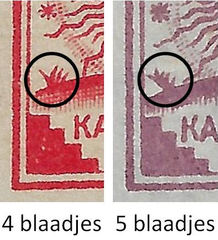
The first issues of Estonia were mainly "Ears in the Sun". Due to a lack of paper, the first version of this was printed on staff maps of the German Army. Later versions were printed on very thin paper and normal paper with and without watermark. Another important difference between the versions is the number of leaves on the left twig. The first issue had four leaves. Later issues had either four or five leaves. In addition, the third and fourth issues also have differences in perforation (imperforate, one-sided perforated and perforated). Of course, there are also shade differences and real color variations.

Issue 1: "Ears in the sun [4 leaves]" printed on German staff maps, imperforate, 1918;
Issue 2: "Aren in de zon [5 leaves]" printed on lined paper, imperforate and perforated, 1919;
Issue 3: "Aren in de zon [5 leaves]", printed on cigarette paper, imperforate, one-sided perforated and perforated, 1919;
Issue 4: "Aren in de zon [5 leaves]", watermarked paper, imperforate, 1919;
Issue 7: "Ears in the sun [4 leaves]", two-tone, serrated, 1919;
Issue 13: "Aren in de zon [4 or 5 sheets]", paper without watermark, perforated, 1920.

Symbolism
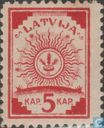
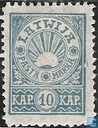
The classic Latvian stamps contain a lot of symbolism. The first stamp shows three ears of wheat united by a band. The three ears of wheat represent the three regions of Latvia: Courland (Kurzeme), Livonia (Livonia) and Latgale (Latgale). The band is of course Latvia (Latvia), whose young existence is represented by the rising sun.

A similar symbolism can be found in the stamp designed and printed as an emergency issue in Northern Estonia. Here too, the rising sun can be seen and the three regions are represented by three stars, united between two circles in which the name Latvia (Latwia) is also included.

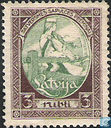
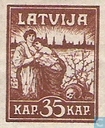
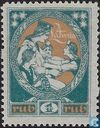
On other stamps Latvia is depicted as a mother and the regions as daughters. As a mother/woman she also holds the helm.

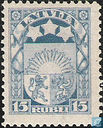
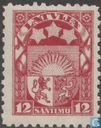
The state coat of arms also shows this symbolism. It is crowned with three stars. The first issue in 1921 is still in rubles and kopeks, but after the monetary reform (based on gold) these stamps were issued in lats and santimu values. First with watermark wide wavy lines, from 1927 with watermark swastika. The latter can occur in normal or inverted position.

Teeth
The young state had its fair share of problems with stamp production. There were hardly any printing facilities, which meant that in the early years a number of stamps had to be issued imperforately. There was also a huge shortage of paper. In addition, inflation was high, which resulted in the necessary new value overprints on existing stamps. Eventually, the situation improved after the monetary reform of 1923, when Rubles and Kopeks were exchanged for Lats = 100 Santimu.
But the outdated perforation machines were still in use. That is why you find the stamps with line perforation. The values 10, 10¾, 11¼ and 11½ occur in all possible combinations.

Special feature
All surcharge stamps mention two values, namely the postage value and the sales value. The difference therefore benefits the charity. Despite the fact that it is not entirely correct technically, we still use the notation with a + between both values in the LD.

Watermarks
Watermarks
Filigrees
Watermarks

F – Sept filigranes used for the timbres-poste de la Lettonie:
E – Seven watermarks were used for the stamps of Latvia:

1) NL Hexagon (multiple)
E Hexagon (multiple)
F Hexagone (multiple)
D Hexagon (multiple)

F En vigueur à partir du April 11, 1919.
E In effect from 11th of April 1919.

F Filigree normal (right).
E Watermark normal (upright).

2) NL Star (six-pointed) in a hexagon and triangle (with rounded points) (multiple)
E Star (six-pointed) in a hexagon and triangle (with rounded points) (multiple)
F Étoile (six branches) in a hexagone and triangle (avec pointes arrondies) (multiple)
D Stern (sechzackig) in a Sechseck und Dreieck (with abgerundeten Punkten) (more)

F En vigueur à partir du 18 november 1919.
E In effect from 18th of November 1919.

F Filigree normal (right).
E Watermark normal (upright).

3) NL Wave line (horizontal) (multiple) (Latvia)
E Wavy line (horizontal) (multiple) (Latvia)
F Ligne ondulée (horizontal) (multiple) (Lettonie)
D Wellenlinie (waarecht) (mehrfach) (Lattland)

F En vigueur à partir du 18 mars 1920.
E In effect from 18th of March 1920.

F Filigree normal (right).
E Watermark normal (upright).

4) NL Wave line (vertical) (multiple wide apart) (Latvia)
E Wavy line (vertical) (multiple wide apart) (Latvia)
F Ligne ondulée (vertical) (multiple large) (Lettonie)
D Wellenlinie (senkrecht) (mehrfach weit auseinander) (Lattland)

F En vigueur à partir du 30 July 1921.
E In effect from 30th of July 1921.

F Filigree normal (droit) ou couché.
E Watermark normal (upright) or sideways.

5) NL Swastika (thin) (multiple)
E Swastika (thin) (multiple)
F Svastika (mince) (multiple)
D Hakenkreuz (dünn) (mehrfach)

F En vigueur à partir du 5 juin 1927.
E In effect from 5th of June 1927.

F Filigree normal (droit) ou renversé.
E Watermark normal (upright) or reversed.

6) NL Wiggle line (multiple)
E Wiggely line (multiple)
F Line entortillée (multiple)
The Snake Line (multiple)

F En vigueur à partir du 21 October 1940.
E In effect from 21st of October 1940.

F Filigree normal (right).
E Watermark normal (upright).

7) NL Rectangle (multiple in each other)
E Rectangle (multiple in each other)
F Rectangle (multiple l'un dans l'autre)
D Rechteck (more ineinander)

F En vigueur à partir du 28 septembre 2000.
E In effect from 28th of September 2000.

F Filigree normal (right).
E Watermark normal (upright).

Automatic translation Click here for the original text
Hide original text

Beknopte geschiedenis

Eerste Wereldoorlog

Gedurende de 19de eeuw was Letland onderdeel van Rusland en werden er Russische postzegels gebruikt. In 1915, tijdens de Eerste Wereldoorlog werd Letland door de Duitsers bezet en maakte het deel uit van het Postgebiet Ober-Ost. Kort voor het einde van de oorlog werd op 22 oktober het Verenigd Baltisch Hertogdom opgericht met als doel het vormen van een personele unie met het Duitse Keizerrijk.

Letse onafhankelijkheidsoorlog

Parallel hieraan hadden Nationalisten in januari 1918 het ondergronds Voorlopig Nationaal Regeringscomité opgericht Na de overgave van het Duitse Keizerrijk op 11 november 1918 riep dit nationalistische comité op 18 november de onafhankelijke republiek Letland uit. Een groot deel van de Duitse troepen trok zich terug, waarop het Russische Rode Leger op 1 december Letland binnenviel. In het bezette deel werd de Letse Socialistische Sovjetrepubliek uitgeroepen. In januari 1919 werd Riga ingenomen waarna de nationalistische regering vluchtte naar het westen (Koerland).

Aanvankelijk vochten de achtergebleven Duitse troepen samen met de Letse troepen tegen de Sovjettroepen. Vanwege tegenstrijdige belangen kwam het tot een breuk en werd op 16 april 1919 een tegenregering opgericht door de Baltisch-Duitse minderheid. Met Duitse steun werd vervolgens het Westrussisch Bevrijdiingsleger opgericht onder leiding van Pavel Bermondt-Avalov (een van de Witte Legers, zie Rusland Burgeroorlogsgebieden).

Met steun van Estse troepen verdrongen de Letse troepen de Witte en Rode Legers. De Letse Socialistische Sovjetrepubliek werd opgeheven en de Russische Socialistische Federatieve Sovjetrepubliek (RSFSR) erkende Letland als onafhankelijke staat in augustus 1920.

Tweede Wereldoorlog

Aan het begin van de Tweede Wereldoorlog werd op 17 juni 1940 Letland door het Rode Leger bezet en in augustus opgenomen in de Sovjet-Unie als Letse Socialistische Sovjetrepubliek. In 1941 werd Letland bezet door het Duitse rijk (zie Duitse Rijk-Bezetting van Letland). Na de bezetting keerde Letland terug in de Sovjet-Unie.

Uiteenvallen Sovjet-Unie

Op 21 augustus 1991 trad Letland uit de Sovjet-Unie en werd het weer een zelfstandige republiek. De Letse onafhankelijkheid werd op 6 september 1991 door de Sovjet-Unie erkend.

Aren in de zon

De eerste uitgiften van Estland waren voornamelijk "Aren in de zon". Vanwege papiergebrek werd de eerste versie hiervan gedrukt op stafkaarten van het Duitse Leger. Latere versies zijn gedrukt op heel dun papier en normaal papier met en zonder watermerk. Een andere belangrijk verschil tussen de versies is het aantal blaadjes aan de linker twijg. De eerste uitgifte had vier blaadjes. Latere uitgiften hadden of vier of vijf blaadjes. Daarnaast kennen de derde en vierde uitgiften ook nog verschillen in tanding (ongetand, eenzijdig getand en getand). Uiteraard zijn er ook nog tintverschillen en echte kleurvariaties.

Uitgifte 1: "Aren in de zon [4 blaadjes]" gedrukt op Duitse stafkaarten, ongetand, 1918;

Uitgifte 2: "Aren in de zon [5 blaadjes]" gedrukt op gelinieerd paper, ongetand en getand, 1919;

Uitgifte 3: "Aren in de zon [5 blaadjes]", gedrukt op sigarettenvloeipapier, ongetand, eenzijdig getand en getand, 1919;

Uitgifte 4: "Aren in de zon [5 blaadjes]", papier met watermerk, ongetand, 1919;

Uitgifte 7: "Aren in de zon [4 blaadjes]", tweekleurig, getand, 1919;

Uitgifte 13: "Aren in de zon [4 of 5 blaadjes]", papier zonder watermerk, getand, 1920.

Symboliek

De klassieke postzegels van Letland bevatten veel symboliek. De eerste zegel toont drie aren die verenigd zijn door een band. De drie aren staan voor de drie deelgebieden van Letland: Koerland (Kurzeme), Lijfland (Livonia) en Letgallen (Latgale). De band is uiteraard Letland (Latvia), waarvan het jonge bestaan wordt weergegeven door de opkomende zon.

Een vergelijkbare symboliek vinden we in de zegel die als nooduitgifte in Noord-Estland is ontworpen en gedrukt. Ook hier is de opgaande zon te zien en worden de drie regios weergegeven met drie sterren, verenigd tussen twee cirkels waarin ook de naam Letland (Latwia) is opgenomen.
Op andere zegels wordt Letland afgebeeld als moeder en de regios als dochters. Als moeder/vrouw heeft ze ook het roer in handen.
Het staatswapen vertoont eveneens deze symboliek. Het wordt bekroond met drie sterren. De eerste uitgave in 1921 is nog in Roebels en Kopeks, maar na de geldsanering (gebaseerd op goud) werden deze zegels in Lats en Santimu waarden uitgebracht. Éérst met watermerk wijde golflijnen, vanaf 1927 met watermerk hakenkruis. Dat laatste kan voorkomen in gewone of omgedraaide stand.
Tandingen

De jonge staat had de nodige problemen bij de postzegelfabricatie. Er waren nauwelijks drukfaciliteiten, waardoor in de beginjaren een aantal zegels ongetand moesten worden uitgegeven. Ook was er een enorme papierschaarste.Daarbij was ook de inflatie hoog, wat resulteerde in de nodige nieuwe waarde-opdrukken op bestaande zegels. Uiteindelijk werd de situatie beter na de geldsanering van 1923, waarbij Roebels en Kopeks werden ingewisseld voor Lats = 100 Santimu.

Maar de verouderde tandingmachines bleven nog in gebruik. Daarom vindt u de zegels met lijntanding. De waarden 10, 10¾, 11¼ en 11½ komen in alle mogelijke kombinaties voor.

Bijzonderheid

Alle toeslagzegels vermelden twee waarden, namelijk de frankeerwaarde en de verkoopwaarde. Het verschil komt dus ten bate van het goede doel. Ondanks dat het technisch niet geheel correct is gebruiken we in de LD toch de notatie met een + tussen beide waarden.

Watermerken

Watermarks

Filigranes

Wasserzeichen

F – Sept filigranes furent utilisés pour les timbres-poste de la Lettonie:

E – Seven watermarks were used for the stamps of Latvia:

1) NL Hexagoon (meervoudig)

E Hexagon (multiple)

F Hexagone (multiple)

D Hexagon (mehrfach)

F En vigueur à partir du 11 avril 1919.

E In effect from 11th of April 1919.

F Filigrane normal (droit).

E Watermark normal (upright).

2) NL Ster (zespuntig) in een hexagoon en driehoek (met geronde punten) (meervoudig)

E Star (six-pointed) in a hexagon and triangle (with rounded points) (multiple)

F Étoile (six branches) dans un hexagone et triangle (avec pointes arrondies) (multiple)

D Stern (sechzackig) in einem Sechseck und Dreieck (mit abgerundeten Punkten) (mehrfach)

F En vigueur à partir du 18 novembre 1919.

E In effect from 18th of November 1919.

F Filigrane normal (droit).

E Watermark normal (upright).

3) NL Golflijn (horizontaal) (meervoudig) (Letland)

E Wavy line (horizontal) (multiple) (Latvia)

F Ligne ondulée (horizontale) (multiple) (Lettonie)

D Wellenlinie (waagerecht) (mehrfach) (Lettland)

F En vigueur à partir du 18 mars 1920.

E In effect from 18th of March 1920.

F Filigrane normal (droit).

E Watermark normal (upright).

4) NL Golflijn (verticaal) (meervoudig breed uit elkaar) (Letland)

E Wavy line (vertical) (multiple wide apart) (Latvia)

F Ligne ondulée (vertical) (multiple large) (Lettonie)

D Wellenlinie (senkrecht) (mehrfach weit auseinander) (Lettland)

F En vigueur à partir du 30 juillet 1921.

E In effect from 30th of July 1921.

F Filigrane normal (droit) ou couché.

E Watermark normal (upright) or sideways.

5) NL Hakenkruis (dun) (meervoudig)

E Swastika (thin) (multiple)

F Svastika (mince) (multiple)

D Hakenkreuz (dünn) (mehrfach)

F En vigueur à partir du 5 juin 1927.

E In effect from 5th of June 1927.

F Filigrane normal (droit) ou renversé.

E Watermark normal (upright) or reversed.

6) NL Kronkellijn (meervoudig)

E Wiggely line (multiple)

F Ligne entortillée (multiple)

D Schlangenlinie (mehrfach)

F En vigueur à partir du 21 octobre 1940.

E In effect from 21st of October 1940.

F Filigrane normal (droit).

E Watermark normal (upright).

7) NL Rechthoek (meervoudig in elkaar)

E Rectangle (multiple in each other)

F Rectangle (multiple l'un dans l'autre)

D Rechteck (mehrfach ineinander)

F En vigueur à partir du 28 septembre 2000.

E In effect from 28th of September 2000.

F Filigrane normal (droit).

E Watermark normal (upright).


Number of stamps
1,929
Number of related items
0
Oldest item
Ears in the sun [4 petals, white] (1918)
Latest item
Alberts Rumba (2025)
Most expensive item
1st flight Latvia - Gambia (€ 900.00)
Date of entry:November 23, 2021 13:46by:Helv
Last updated :September 14, 2024 22:55by:Loriot

Latvia stamp catalogue
  • 1
  • 2
  • 3
  • 4
  • 5
  • ..
  • 33
  • >
1,929 selected
Ears in sun
Ears in sun
  • 1918
  • 5
Ears in Sun
Ears in Sun
  • 1918
  • 5
Ears in the sun [4 petals, white]
  • 1918
  • 5
Ears in the sun [4 petals, fine lines]
  • 1918
  • 5
Ears in the sun [4 petals, coarse lines]
  • 1918
  • 5
Ears in Sun
Ears in Sun
  • 1918
  • 5
Ears in the Sun [5 sheets, lined paper]
  • 1919
  • 10
Ears in the Sun [5 sheets, lined paper]
  • 1919
Ears in Sun
€ 
0
.
30
Ears in Sun
  • 1919
  • 5
Ears in the Sun [5 leaves, thin paper]
€ 
0
.
50
Ears in the Sun [5 leaves, thin paper]
  • 1919
  • 10
Ears in sun
€ 
0
.
40
Ears in sun
  • 1919
  • 15
Ears in the Sun [5 leaves, thin paper]
€ 
0
.
40
Ears in the Sun [5 leaves, thin paper]
  • 1919
  • 20
Ears in the Sun [5 leaves, thin paper]
  • 1919
  • 25
Ears in the Sun [5 leaves, thin paper]
  • 1919
  • 35
Ears in the Sun [5 leaves, thin paper]
€ 
0
.
40
Ears in the Sun [5 leaves, thin paper]
  • 1919
  • 50
Ears in the Sun [5 leaves, thin paper]
€ 
4
.
00
Ears in the Sun [5 leaves, thin paper]
  • 1919
  • 15
Ears in the Sun [5 leaves, thin paper]
€ 
6
.
00
Ears in the Sun [5 leaves, thin paper]
  • 1919
  • 20
Ears in the Sun [5 leaves, thin paper]
  • 1919
  • 50
No image
€ 
0
.
80
Ears in the Sun [5 leaves, thin paper]
  • 1919
  • 5
Ears in the Sun [5 leaves, thin paper]
  • 1919
  • 20
Ears in the Sun [5 leaves, thin paper]
€ 
10
.
00
Ears in the Sun [5 leaves, thin paper]
  • 1919
  • 50
Ears in the Sun [5 leaves, thin paper]
  • 1919
  • 75
Ears in the Sun [5 petals, watermark]
€ 
0
.
20
Ears in the Sun [5 petals, watermark]
  • 1919
  • 3
Ears in the Sun [5 petals, watermark]
€ 
0
.
40
Ears in the Sun [5 petals, watermark]
  • 1919
  • 5
Ears in the Sun [5 petals, watermark]
  • 1919
  • 10
Ears in the Sun [5 petals, watermark]
€ 
0
.
20
Ears in the Sun [5 petals, watermark]
  • 1919
  • 15
 Ears in the Sun [5 petals, watermark]
€ 
0
.
50
Ears in the Sun [5 petals, watermark]
  • 1919
  • 20
Ears in the Sun [5 petals, watermark]
  • 1919
  • 25
Ears in the Sun [5 petals, watermark]
€ 
0
.
80
Ears in the Sun [5 petals, watermark]
  • 1919
  • 35
Ears in the sun
€ 
0
.
40
Ears in the sun
  • 1919
  • 50
Ears in the Sun [5 petals, watermark]
  • 1919
  • 75
Ears in the sun [5 leaves, watermark]
€ 
0
.
80
Ears in the sun [5 leaves, watermark]
  • 1919
  • 3
Ears in the Sun [5 petals, watermark]
  • 1919
  • 5
Ears in the Sun [5 petals, watermark]
€ 
0
.
20
Ears in the Sun [5 petals, watermark]
  • 1919
  • 15
Liberation of Riga
Liberation of Riga
  • 1919
  • 5
Liberation of Riga
Liberation of Riga
  • 1919
  • 15
Liberation of Riga
Liberation of Riga
  • 1919
  • 35
Liberation of Riga
€ 
1
.
00
Liberation of Riga
  • 1919
Liberation of Riga
Liberation of Riga
  • 1919
  • 5
Liberation of Riga
€ 
3
.
00
Liberation of Riga
  • 1919
  • 15
North Latvia
North Latvia
  • 1919
  • 10
North Latvia
North Latvia
  • 1919
  • 10
Liberation of Riga [thin paper]
€ 
17
.
50
Liberation of Riga [thin paper]
  • 1919
  • 5
 Liberation of Riga [thin paper]
€ 
17
.
50
Liberation of Riga [thin paper]
  • 1919
  • 15
Liberation of Riga [thin paper]
€ 
25
.
00
Liberation of Riga [thin paper]
  • 1919
  • 35
 Ears in the Sun [4 leaves, laid paper]
€ 
1
.
40
Ears in the Sun [4 leaves, laid paper]
  • 1919
  • 3
Ears in sun
Ears in sun
  • 1919
  • 5
Independence [34 x 45mm]
€ 
2
.
00
Independence [34 x 45mm]
  • 1919
  • 10
Independence [34 x 45mm]
  • 1919
  • 10
Independence [34 x 45mm]
€ 
0
.
15
Independence [34 x 45mm]
  • 1919
  • 10
Independence [34 x 45mm]
€ 
0
.
30
Independence [34 x 45mm]
  • 1919
  • 10
Independence [28 x 38mm]
€ 
0
.
30
Independence [28 x 38mm]
  • 1919
  • 10
Independence [28 x 38mm]
€ 
0
.
30
Independence [28 x 38mm]
  • 1920
  • 35
 Independence [28 x 38mm]
€ 
0
.
80
Independence [28 x 38mm]
  • 1919
  • 1
Independence
Independence
  • 1919
  • 10
Independence
Independence
  • 1920
  • 35
Liberation Courland and Semigallia
€ 
0
.
20
Liberation Courland and Semigallia
  • 1919
  • 10
Liberation Courland and Semigallia
€ 
0
.
25
Liberation Courland and Semigallia
  • 1919
  • 25
Liberation Courland and Semigallia
  • 1920
  • 35
Liberation Courland and Semigallia
€ 
1
.
20
Liberation Courland and Semigallia
  • 1920
  • 1
  • Get to know us
  • About LastDodo
  • Catalogue
  • Buy
  • Sell
  • Subscriptions
  • Help
  • How does it work?
  • Frequently Asked Questions
  • Contact
  • Forum
  • Return and refund policy
  • Explore
  • Stamps buy and sell
  • Comic books buy and sell
  • Coins buy and sell
  • Books buy and sell
  • Music buy and sell
  • Film buy and sell
  • Postcards buy and sell
  • Trading cards buy and sell
  • Cigar bands buy and sell
  • Model cars buy and sell
© 2026 LastDodo
Terms of usePrivacy policyCookie policy