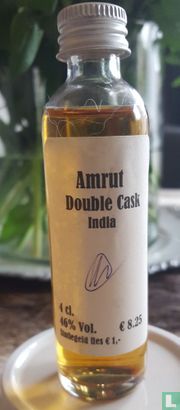
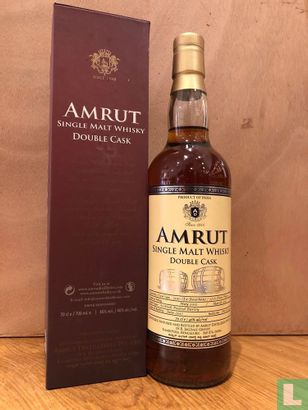
Amrut double cask. For Double Cask, Amrut selects two very different barrels that are bottled after a marriage. For the third edition, these were a bourbon barrel (# 3190, filled in May 2012) and a port pipe (# 2716, filled in March 2012). Both contain whiskey distilled from Scottish peated malt. In June 2017 it was bottled at a strength of 46% at the age of five. Only 900 bottles are available in total.
Amrut was the very first Indian single malt whiskey and was introduced in Glasgow on August 24, 2004. The name comes from Sanskrit and means something like “nectar of the gods”, the company itself translates it as “elixir of life”. Amrut Distilleries Ltd. was founded in Bangalore in 1948 by JN Radhakrishna Rao Jagdale. His son Neelakanta joined the company in 1972 and decided in 1982 that Amrut should start producing a premium whiskey. Until then, only so-called Indian Made Foreign Liquor was made. Initially, the locally grown barley was distilled together with molasses and sold as Prestige Blended Malt Whiskey. From 1986 both raw materials were distilled separately, the malt whiskey was aged for a year and the blend was sold as MaQintosh Premium Whiskey. Increasingly convincing of the quality of the malt whiskey and the fact that for the Indian flavor less and less was used in the blend, Neelakanta decided in 2001 that Amrut should be sold as a single malt. After extensive market research in Scotland by his son Rakshit, the time had come in 2004. First it was Europe's turn, the rest of the world did not follow until 2009. The current distillery was built in 1987 in Kambipura. There are six stainless steel washbacks of 10,000 liters each and two copper pot stills of 5000 liters. The barley used is from Haryana, Punjab and Rajasthan, except for peated malt, which is imported from Scotland. The barley is malted in Jaipur and Delhi. Fermentation takes six days and uses water from a source 25 kilometers away. The distillery has a capacity of 200,000 liters of pure alcohol per year. Due to the altitude (1000 meters above sea level) and the hot and humid climate in Bangalore, the maturation is much faster here, the whiskey is generally bottled after about four years. The angels' share is between 10 and 16% per year. Amrut whiskey is not cold filtered and not colored before bottling. The distillery is not very automated, the company has opted for ample employment and employs some 450 people.
Tasting note: color: dark old gold. Nose: aromas of greasy peat smoke and wet earth are accompanied by strawberries, blueberries, vanilla, caramel, oak, freshly roasted nuts, leather, gingerbread spice and some floral notes. Taste: Notes of vanilla, peach, orange, chocolate, ginger, cardamom and cumin are beautifully supported by subtle notes of peat smoke. In the long and juicy finish it has notes of dried fruit, vanilla, coconut and ripe mango, while notes of smoke and ash are constantly present.
This text has been translated automatically from Dutch
Click here for the original text
Amrut double cask. Voor Double Cask selecteert Amrut twee zeer verschillende vaten die na een marriage gebotteld worden. Voor de derde editie waren dat een bourbonvat (#3190, gevuld in mei 2012) en een port pipe (#2716, gevuld in maart 2012). Beide bevatten whisky die was gestookt uit Schotse geturfde mout. In juni 2017 werd hij met een leeftijd van vijf jaar gebotteld op een sterkte van 46%. Er zijn in totaal slechts 900 flessen beschikbaar.
Amrut was de allereerste Indiase single malt whisky en werd op 24 augustus 2004 geïntroduceerd in Glasgow. De naam komt uit het Sanskriet en betekent zoiets als “nectar van de goden”, de firma zelf vertaalt het als “levenselixer”. Amrut Distilleries Ltd. werd in 1948 in Bangalore opgericht door JN Radhakrishna Rao Jagdale. Zijn zoon Neelakanta kwam in 1972 bij het bedrijf en hij besloot in 1982 dat Amrut een premium whisky moest gaan produceren. Tot die tijd werd slechts zgn. Indian Made Foreign Liquor gemaakt. In eerste instantie werd de lokaal verbouwde gerst samen met melasse gedistilleerd en als Prestige Blended Malt Whisky verkocht. Vanaf 1986 werden beide grondstoffen apart gedistilleerd, kreeg de malt whisky een jaar rijping en werd de blend verkocht als MaQintosh Premium Whisky. Steeds overtuigder van de kwaliteit van de malt whisky en het feit dat voor de Indiase smaak steeds minder gebruikt werd in de blend, besloot Neelakanta in 2001 dat Amrut als single malt verkocht moest gaan worden. Na uitgebreid marktonderzoek in Schotland door zijn zoon Rakshit was het dan in 2004 zover. Eerst was Europa aan de beurt, de rest van de wereld volgde pas vanaf 2009. De huidige distilleerderij werd in 1987 in Kambipura gebouwd. Er staan zes rvs washbacks van 10.000 liter elk en twee koperen pot stills van 5000 liter. De gebruikte gerst komt uit Haryana, Punjab en Rajasthan, behalve de geturfde mout, die wordt uit Schotland geïmporteerd. De gerst wordt in Jaipur en Delhi gemout. De vergisting neemt zes dagen in beslag en hiervoor wordt water uit een bron die 25 kilometer verderop ligt gebruikt. De distilleerderij heeft een capaciteit van 200.000 liter pure alcohol per jaar. Door de hoogte (1000 meter boven zeeniveau) en het hete en vochtige klimaat in Bangalore verloopt de rijping hier veel sneller, de whisky wordt over het algemeen na ongeveer vier jaar gebotteld. Het angels’ share bedraagt tussen de 10 en 16% per jaar. Amrut whisky wordt voor botteling niet koud gefilterd en niet bijgekleurd. Op de distilleerderij is slechts weinig geautomatiseerd, de firma heeft gekozen voor ruime werkgelegenheid en er werken dan ook zo’n 450 mensen.
Proefnotitie: kleur: donker oud goud. Neus: aroma’s van vettige turfrook en natte aarde krijgen gezelschap van aardbeien, bosbessen, vanille, karamel, eikenhout, vers gebrande noten, leer, peperkoekkruiden en wat bloemige accenten. Smaak: tonen van vanille, perzik, sinaasappel, chocolade, gember, kardemom en komijn worden prachtig ondersteund door subtiele tonen van turfrook. In de lange en sappige afdronk heeft hij tonen van gedroogd fruit, vanille, kokos en rijpe mango, terwijl tonen van rook en as voortdurend aanwezig zijn.