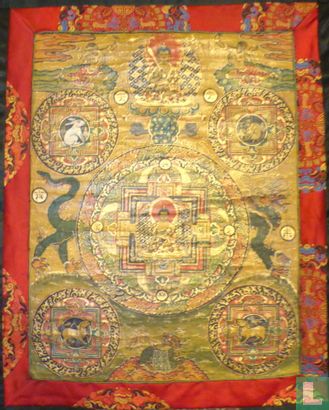
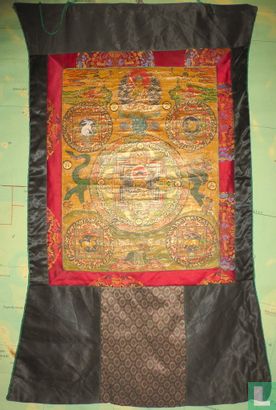
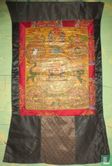
Elder painted Thangka,
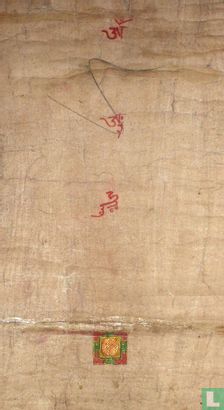
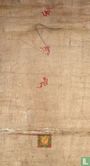
Three root sylabes characters on the back
Rather strange that it also contains Chinese / Japanese characters
(info this); info Tibetan.
It is the story of "The four friends".
The picture shows a Tree, Elephant, Monkey, Rabbit, Bird. The Elephant is in the middle, on top of that the Monkey, on it Rabbit and finally the Bird.
The question is they ask each other, "who is the oldest"?
The misleading thing about this story is the image. The animals are stacked on top of each other, from large to small. Everyone looks to the Elephant as being the oldest. After bickering between the four friends of mine, I am the oldest, the Bird shouts from above no I am the oldest.
The Bird had once dropped the seed in a flight and now there is a big fat Tree that has withstood time for years.
It is a story that many a Tibetan still remembers from his childhood years and that makes him happy if you let yourself be deceived
A thangka, also called t (h) an (g) ka, is a painted or embroidered Tibetan Buddhist banner originally hung in a monastery or over a family altar and carried by monks during ceremonial processions. The Tibetan word thang means flat and indicates that a thangka is a painting on a flat surface, which, however, can be rolled up when no display is required. Because of the latter, it is also called a scroll painting. The most common shape of the thangka is rectangular in portrait view. The picture is traditionally painted on cotton prepared with glue drawn from yak skin mixed with lime. Pigments with yak fat as a binder are used as paint. This paint is waterproof and elastic after drying. The thangka usually has a silk veil to protect the image from light if desired
This text has been translated automatically from Dutch
Click here for the original text
Oudere geschilderde Thangka ,
Op achterkant drie root sylabes tekens
Eerder vreemd dat er ook Chinese/Japanse karakters opstaan
(info deze );info Tibetaan.
Het is het verhaal van "De vier vriendjes".
Op de afbeelding staat een Boom, Olifant, Aap, Konijn, Vogel. De Olifant staat in het midden, daarbovenop de Aap, daarop Konijn en als laatste de Vogel.
De vraag is die ze elkaar stellen, "wie is de oudste"?
Het misleidende van dit verhaal is de afbeelding. De dieren zijn op elkaar gestapeld, van groot naar klein. Iedereen kijkt naar de Olifant als zijnde de oudste. Na onderling gekibbel tussen de vier vriendjes van ik ben de oudste, krijst de Vogel van boven nee ik ben de oudste.
De Vogel had op een keer in een vlucht het zaadje laten vallen en nu staat daar een grote dikke Boom die al jaren de tijd heeft doorstaan.
Het is een verhaaltje, wat menig Tibetaan nog uit zijn kinderjaren weet te herinneren en hem doet plezieren als je, je laat misleiden
Een thangka, ook wel t(h)an(g)ka is een geschilderd of geborduurd Tibetaans boeddhistische banier die oorspronkelijk in een klooster of boven een familiealtaar werd gehangen en tijdens ceremoniële processies werd gedragen door monniken. Het Tibetaanse woord thang betekent vlak en geeft weer dat een thangka een schildering is op een plat oppervlak, die echter opgerold kan worden wanneer er geen vertoning nodig is. Om dit laatste wordt het ook wel een rolschildering (scroll-painting) genoemd. De meest voorkomende vorm van de thangka is rechthoekig in staande weergave. De afbeelding wordt traditioneel geschilderd op katoen geprepareerd met lijm getrokken uit jakhuid vermengd met kalk. Als verf gebruikt men pigmenten met als bindmiddel jakvet. Deze verf is na droging watervast en elastisch. De thangka heeft meestal een zijden voorhang om de afbeelding desgewenst te beschermen tegen lichtinvloeden