
Catalogue information
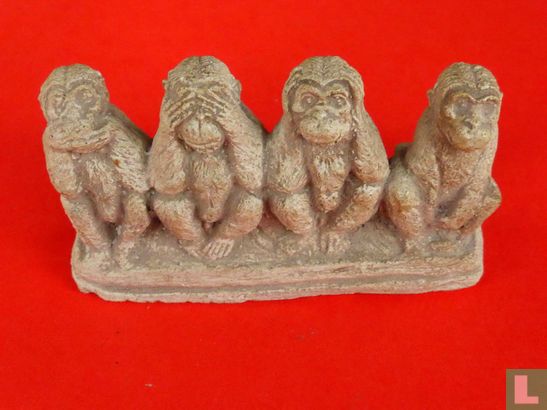
Material type of stone Hear, see and speak no evil with the addition of Fourth Monkey (Shizaru, does no harm) originates from the teachings of the philosopher Confucius, who lived from 551 to 479 BC in China. He says to his disciples, "Do not look at, do not listen to, do not speak out, or focus on what is contrary to decency." Nikko in Japan (150 km northeast of Tokyo) is home to the Nikko Toshogu shrine. Within this sanctuary is "the stable of the sacred fungus." It contains eight wood reliefs, which depict the course of man's life. These panels were created in 1636 by the sculptor Hidari Jingorō. A panel on the façade of the stable shows three monkeys with their hands over the ears, eyes and mouth. This panel depicts the youth and is based on the wisdom of Confucius. Jingoro used monkeys for his panels, as monkeys were important in the religions of China and Japan. One of the Eastern gods was Shōmen-Kongō. To worship this god, various sculpture groups of the three monkeys were made in Japan. The oldest statues date from 1528 and 1548. That is one hundred years before the shrine in Nikko and Toshogu was built. The three monkeys in Japan are called Mizaru, with his hands over his eyes (sees no evil), Kikazaru, with his hands on his ears (hear no evil) and Iwazaru, with his hands over his mouth (speak no evil). Sometimes a fourth monkey is depicted: this is called Shizaru and depicts "does no harm". He has his hands on his stomach, over his genitals or crossed
This text has been translated automatically from Dutch
Click here for the original text