Enlarge image
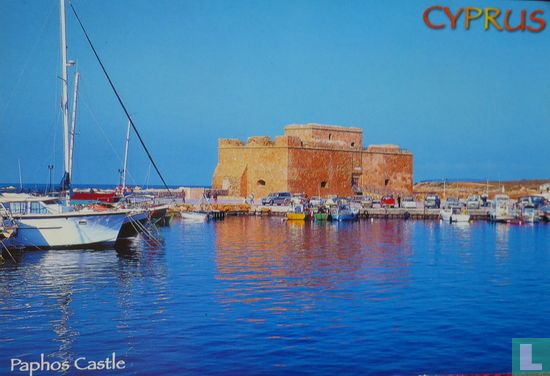
Cyprus Paphos Castle
Catalogue information
LastDodo number
4643457
Area
Postcards
Title
Cyprus Paphos Castle
City
Street
Province / region
Country
Type
Year
Collection
Number (on) postcard
15
Barcode / EAN / UPC
Designer
Publisher as on card
General name of the publisher
Theme
Printing technique
Dimensions
16.0 x 11.0 cm
Details
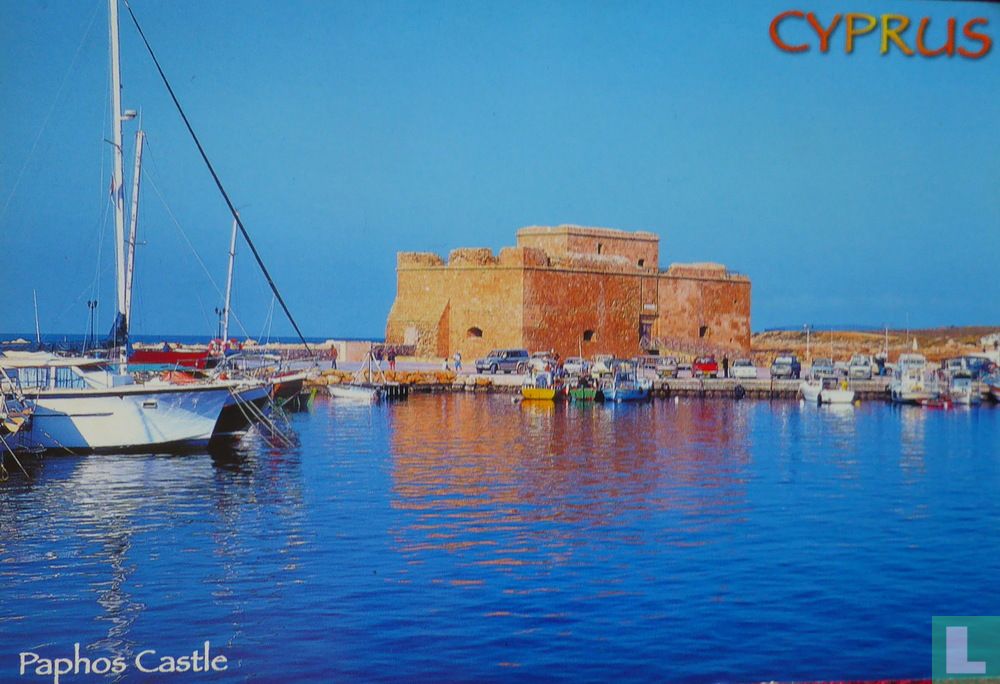
Paphos Castle is located on the edge of Paphos harbour. It was originally built as a Byzantine fort to protect the harbour. It was then rebuilt by the Lusignans in the thirteenth century after being destroyed in the earthquake of 1222. In 1570 it was dismantled by the Venetians. After capturing the island, the Ottomans restored and strengthened it. Throughout the ages it has seen many uses. It has served as a fortress, a prison and even a warehouse for salt during the British occupation of the island. More recently the castle serves as a backdrop to the annual open air Paphos cultural festival which takes place in September.[1]
It was declared a listed building in 1935 and represents one of the most distinctive landmarks of the city of Paphos. Several archaeological excavations have taken place to investigate its past.
Cyprus Listeni/ˈsaɪprəs/ (Greek: Κύπρος [ˈcipros]; Turkish: Kıbrıs [ˈkɯbɾɯs]), officially the Republic of Cyprus (Greek: Κυπριακή Δημοκρατία; Turkish: Kıbrıs Cumhuriyeti), is an island country in the Eastern Mediterranean Sea.[6] Cyprus is the third largest and third most populous island in the Mediterranean, and a member state of the European Union. It is located south of Turkey, west of Syria and Lebanon, northwest of Israel, north of Egypt and east of Greece.
The earliest known human activity on the island dates to around the 10th millennium BC. Archaeological remains from this period include the well-preserved Neolithic village of Khirokitia, and Cyprus is home to some of the oldest water wells in the world.[7]
The earliest known foreign settlements on the island were mainly of Phoenicians and Greeks, with Phoenician culture dominating the island's eastern and southern parts. Cyprus was settled by Mycenaean Greeks in two waves in the 2nd millennium BC, though Greek culture did not come to dominate on the island until its conquest by Alexander the Great.