




Catalogue information
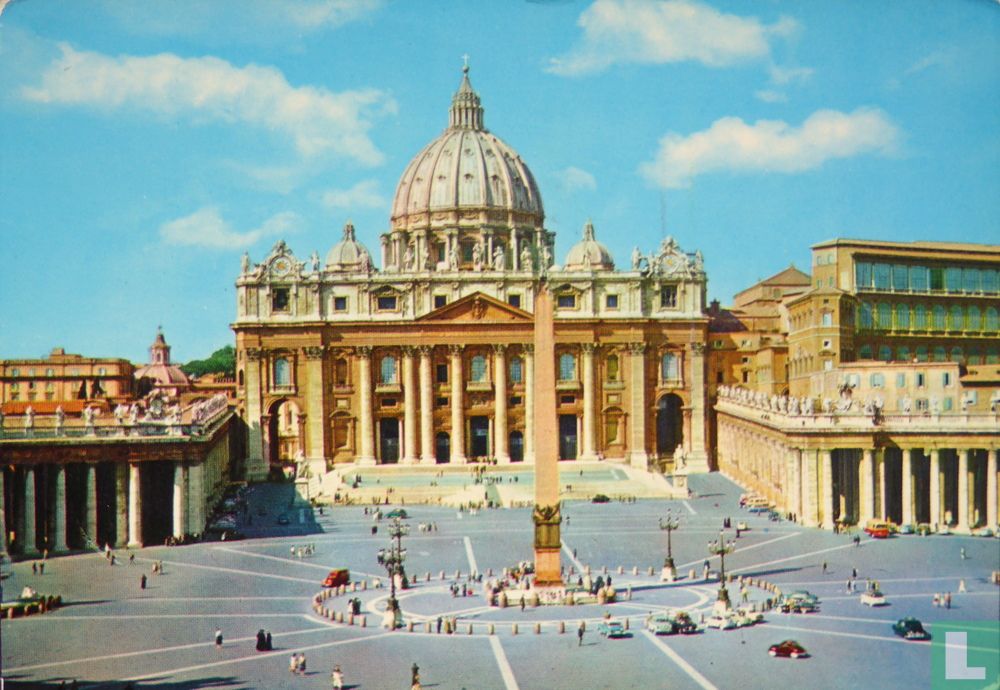
Postmark Poste Roma Appio July 28, 1964. Stamp 15 LIre Fresco Michelangelo N° Yvert 829 issue year stamp 1961 St. Peter's Square (Italian: Piazza San Pietro) is a square in Vatican City. St. Peter's Basilica is located on the square. It was designed by Gian Lorenzo Bernini, who used a classical style as a platform combined with baroque style elements. St. Peter's Square was built between 1656 and 1667. The square is 240 meters wide and 340 meters long. It is surrounded by 284 Doric columns and 88 pillars arranged in four rows. The colonnade (also called 'the motherly arms of the church') contains 140 statues of saints.[1] The rows of columns form an ellipse (with an inner diameter of approximately 198 meters) that extends slightly wider towards the church, so that it rises even more impressively. On the square one can see a round stone embedded in the ground both to the left and right of the obelisk (towards the fountains). These stones are the foci of the ellipse. When standing on this, one can see only one column of the four rows of columns that stand behind each other. All columns of the colonnade are aligned from here. In the middle of the square is an Egyptian obelisk that is 40 meters high and weighs 340 tons. This so-called Vatican Obelisk was built in 37 AD. B.C. Brought from Egypt to Rome by Emperor Caligula. The obelisk originally stood in Nero's circus, over which the old St. Peter's Church was partly built in the 4th century. In 1586, on the orders of Pope Sixtus V, it was moved to St. Peter's Square, which looked different at the time. Nine hundred workmen, with the help of seventy-five or one hundred and fifty horses and many pulleys and ropes, placed the obelisk in the middle of the square. Consider the story about a Genoese sailor who shouted, "Aqua alle fulli" (water on the ropes), when the ropes threatened to break and the obelisk could fall. In the Middle Ages it was thought that the top of the obelisk contained an urn containing the ashes of Julius Caesar. Today there is a cross on the top of the obelisk, so that it is now 41 meters high. Marble stones in the floor around the obelisk indicate the cardinal directions.
This text has been translated automatically from Dutch
Click here for the original text