

Catalogue information
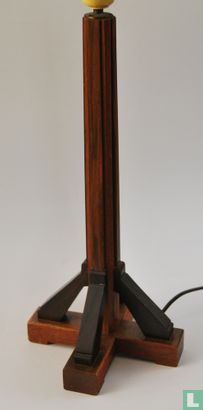
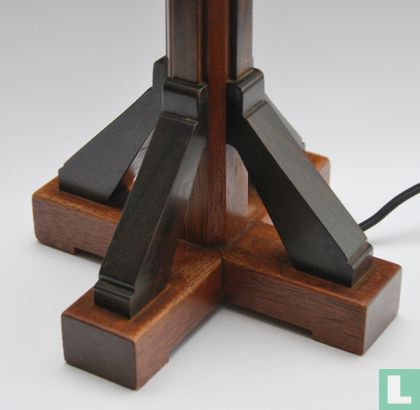
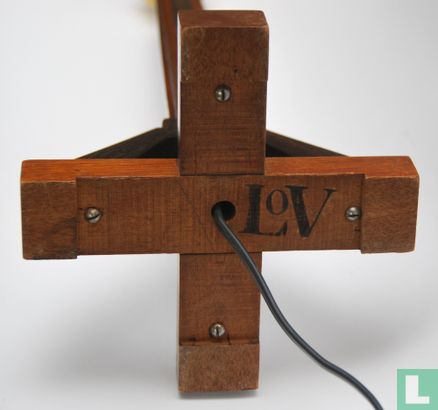
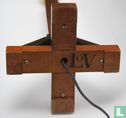
The 'NV Oosterbeeksche Meubelfabriek Labor Omnia Vincit' (Labor Overcomes Everything) has been a unique company. Founder Gerrit Pelt (1864-1956) was an idealistic and social-minded businessman who had worked as an architect and contractor and, thanks to a number of successful projects, had earned so much money that he was able to retire in 1906. However, he did not like this in the least and so he decided to return to business in 1909, but now in a way that was more in line with his ideals. He gave to L.O.V. a cooperative form, which boiled down to the workers sharing in the profit. The management remained in the hands of Pelt himself, who, however, ensured that the working conditions and social facilities were at a very high level for that time. The idealism behind L.O.V. was also reflected in the pursuit of good, modern design and high-quality use of materials. Pelt attracted several progressive designers for this. In the beginning, H.F. Mertens (1885-1960) most models, in a fairly austere style, which is in keeping with the 'constructive' designs of H.P. Berlage, Jac. van den Bosch and Willem Penaat, but from 1915 onwards the number of designers expanded considerably and the stylistic diversity increased. Most of these new (freelance) employees were architects, including J.B. van Loghem (1881-1940), H. Fels (1882-1962), A.P. Smits (1881-1957), J. Crouwel (1885-62), A.F. van der Wey (1885-?) and J.C. Jansen (1897-?). In their midst, Cor Alons (1892-1967) was one of the few specialist interior designers. The style of their designs varies from moderately Amsterdam School-esque to not too extremely functionalist. Most models, however, came from two permanent employees: J.A. Muntendam (1882-1938), who was 'technical director' from 1916 to 1934, and Frits Spanjaard (1887-1978), who was 'artistic director' from 1919 and even co-director from 1920, but in 1922 after disagreement with Pelt already left again. They both had a fairly functionalist attitude and it is undoubtedly due to this that the L.O.V.production has acquired a distinct identity of its own, characterized by calm and modesty. From time to time the factory also carried out assignments for third parties. Around 1922, for example, paneling and some furniture for the Sint Hubertus castle in the Hoge Veluwe were manufactured after a design by Berlage, while at the same time furniture was also produced for the PTT after a design by Cornelis de Lorm and Penaat. Another important project was the furnishing of the State Hall of the Gelderland Provincial House in Arnhem, designed by Willem Gispen in 1924. The economic malaise of the 1930s would kill the company. Despite their austere appearance, L.O.V. furniture was never really cheap and therefore competition could no longer be adequately met in these difficult times. Exactly a quarter of a century after its foundation, L.O.V. liquidated.
This text has been translated automatically from Dutch
Click here for the original text