CUBB
It is often claimed that the game originated during the Viking Age and that it was preserved on Gotland, but that appears to be a marketing story by manufacturers of the game and cannot be confirmed. There are folktales that prove that Kubb was played in various places in Sweden in the early twentieth century, but it remains to be seen how much the rules of that time correspond to the way the game is played today. It is worth noting that the Föreningen Gutnisk Idrott, which was founded in 1912, never named the game as one of the traditional Gotland games. The game shows similarities with other bowling-like games and it is possible that these games share a common medieval resource. The strongest deviation that characterizes Kubb, the fact that two teams face each other, seems to be a twentieth century invention.
The first commercial Kubb games were produced in the 1990s and the previously unknown game quickly became very popular. There is now international interest in the game and since 1995 world championships have been held annually in Gotland.
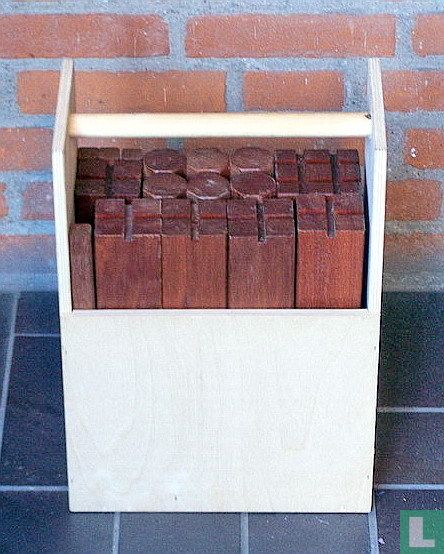
Parts of the game
The game consists of 21 parts:
Ten kubbs, beam-shaped wooden blocks about 15 cm high and 7 x 7 cm in diameter.
A king, a larger beam-shaped wooden block about 30 cm high and 9 x 9 cm in diameter, sometimes with a crown at the top.
Six throwing sticks, wooden cylindrical sticks about 30 cm long and 3 to 5 cm in diameter. Official diameter used at the World Cup and NK Kubb is 44 millimeters.
Four corner sticks or other markings to indicate the corners of the field. Match dimensions of the playing area are 5 x 8 meters.
Starting position
Kubb is normally played on a rectangular field of approximately 5 by 8 meters. There are no official rules about the size of the field and the field size can be reduced for younger players or to shorten the game time. The material played on is usually grass, but the game can also be played on any other solid ground type.
The corner sticks are inserted into the ground to define the field. There are no further markers to indicate the edges of the field. The narrow edges of the field are called the "baselines".
The king is placed in the center of the square. An imaginary line, parallel to the baselines, separates the court into two halves.
The kubbs are dropped on the baselines. There are five on each line.
Rules
The number of participants in the game can be determined without obligation. Usually, each team has an equal number of players.
Each turn in the game consists of two phases for each team.
Team A throws the six throwing sticks from the baseline to the kubbs standing on the opponent's baseline. The throw must be underhand and the sticks must touch the kubbs with the ends. It is not allowed to throw the sticks sideways or throw them in such a way that they arrive sideways.
The kubbs knocked over by Team A are then thrown into Team A's half by Team B. Team A then places these kubbs upright where they landed. These kubbs are called field kubbs and are different from the kubbs placed on the baseline at the start of the game.
Now it's up to team B to knock over team A's kubbs. Before knocking down the kubbs on the baseline, any field kubbs must be knocked down first. Any kubbs knocked down under these rules are then thrown back into Team B's field by Team A.
If a team fails to knock down all the field kubbs on the opposite side of the field, the kubb still standing furthest forward determines the new baseline. For knocking down kubbs, players may now walk forward to this imaginary baseline. This rule only applies to knocking over kubbs. For knocking over the king and throwing kubbs to the other side, the original baseline must be used.
In this way, the game continues until one team knocks down all the kubbs on the opposite side. If the throwing team then has throwing sticks left, they can be used to knock down the king from the original baseline. If successful, this team has won the game.
During the game, if the king is knocked down by someone too early, the opposing team has won the game and the game ends immediately.
Often a "best-of-three" is played, in which the team that first won two rounds of play can call themselves the winner.
This text has been translated automatically from Dutch
Click here for the original text
KUBB
Er wordt vaak beweerd dat het spel is ontstaan tijdens het tijdperk van de Vikingen en dat het bewaard is gebleven op Gotland, maar dat lijkt een marketingverhaal te zijn van fabrikanten van het spel en kan niet worden bevestigd. Er zijn volksverhalen die bewijzen dat Kubb werd gespeeld op diverse plaatsen in Zweden in het begin van de twintigste eeuw, maar het is nog de vraag in hoeverre de regels van toen overeenkomen met de manier waarop het spel tegenwoordig wordt gespeeld. Het is van belang om te vermelden dat de Föreningen Gutnisk Idrott dat in 1912 werd gesticht, het spel nooit heeft benoemd als een van de traditionele spellen uit Gotland. Het spel toont overeenkomsten met andere bowlingachtige spellen en het is mogelijk dat deze spellen een gemeenschappelijke middeleeuwse bron delen. De sterkste afwijking die Kubb kenmerkt, het feit dat er twee teams tegenover elkaar staan, lijkt een uitvinding uit de twintigste eeuw.
In de jaren negentig werden de eerste commerciële Kubbspellen geproduceerd en het voorheen onbekende spel werd snel erg populair. Er is nu internationale interesse voor het spel en sinds 1995 worden jaarlijks wereldkampioenschappen gehouden in Gotland.
Onderdelen van het spel
Het spel bestaat uit 21 onderdelen:
Tien kubbs, balkvormige houten blokken van ongeveer 15 cm hoog en 7 x 7 cm doorsnee.
Een koning, een groter balkvormig houten blok van ongeveer 30 cm hoog en 9 x 9 cm doorsnee, met soms een kroon aan de bovenkant.
Zes werpstokken, houten cilindervormige stokken van ongeveer 30 cm lang en met een diameter van 3 tot 5 cm. Officiële diameter gehanteerd op het WK en NK Kubb is 44 millimeter.
Vier hoekstokken of andere markeringen om de hoeken van het veld aan te duiden. Wedstrijdafmetingen van het spelterrein zijn 5 x 8 meter.
Beginopstelling
Kubb wordt normaliter gespeeld op een rechthoekig veld van ongeveer 5 bij 8 meter. Er zijn geen officiële regels over de grootte van het veld en de veldgrootte kan worden verkleind voor jongere spelers of om de spelduur te verkorten. Het materiaal waarop gespeeld wordt, is meestal gras, maar het spel kan ook worden gespeeld op elk ander solide grondtype.
De hoekstokken worden in de grond gestoken om het veld te definiëren. Er zijn geen verdere markeringen om de randen van het veld mee aan te duiden. De smalle randen van het veld worden de "basislijnen" genoemd.
De koning wordt in het midden van het veld geplaatst. Een denkbeeldige lijn, evenwijdig aan de basislijnen, scheidt het veld in twee speelhelften.
De kubbs worden neergezet op de basislijnen. Op elke lijn komen er vijf te staan.
Regels
Het aantal deelnemers aan het spel kan vrijblijvend worden bepaald. Meestal heeft elk team een gelijk aantal spelers.
Elke beurt in het spel bestaat uit twee fasen voor elk team.
Team A gooit de zes werpstokken vanaf de basislijn naar de kubbs die bij de tegenpartij op de basislijn staan. Er moet onderhands worden gegooid en de stokken moeten met de uiteinden de kubbs raken. Het is niet toegestaan om de stokken overdwars te gooien of ze zo te gooien dat ze overdwars aankomen.
De kubbs die door team A zijn omgegooid, worden vervolgens door team B in de speelhelft van team A gegooid. Team A zet deze kubbs vervolgens rechtop op de plaats waar zij zijn neergekomen. Deze kubbs worden veldkubbs genoemd en verschillen van de kubbs die bij de start van het spel op de basislijn zijn geplaatst.
Nu is het aan team B om de kubbs van team A omver te gooien. Voordat de kubbs op de basislijn mogen worden omgegooid, dienen eerst de eventuele veldkubbs omver te worden gegooid. Alle kubbs die volgens deze regels omver worden gegooid, worden vervolgens door team A weer in het veld van team B gegooid.
Als een team het niet voor elkaar krijgt om alle veldkubbs aan de overzijde van het veld omver te gooien, bepaalt de nog staande kubb die het verst naar voren staat de nieuwe basislijn. Voor het omvergooien van kubbs mogen de spelers nu naar voren lopen naar deze denkbeeldige basislijn. Deze regel is alleen van toepassing op het omvergooien van kubbs. Voor het omvergooien van de koning en het gooien van kubbs naar de overzijde moet de oorspronkelijke basislijn worden gebruikt.
Op deze manier duurt het spel voort totdat een team alle kubbs aan de overzijde omver heeft gegooid. Als het gooiende team dan nog werpstokken over heeft, kunnen deze worden gebruikt om vanaf de oorspronkelijke basislijn de koning omver te gooien. Als dat lukt, heeft dit team het spel gewonnen.
Als tijdens het spel de koning te vroeg door iemand omver wordt gegooid, heeft het andere team het spel gewonnen en is het spel direct beëindigd.
Vaak wordt een "best-of-three" gespeeld, waarbij het team dat als eerste twee spelrondes heeft gewonnen, zich winnaar mag noemen.