New to LastDodo?See how it works
New here? LastDodo is rated
99.2% positive in 730,880 shop reviews. Find out how it works
BuySellCatalogueCollection Wish list Forum
EN
NederlandsEnglishFrançaisDeutsch
Shopping cart of:
You have more shopping carts
View 9 shopping carts from other shops
Shopping cart

The shopping cart is currently empty.

Sign inFrequently Asked Questions
Sign in
StampsComic booksCoinsBooksMusicFilmPostcardsTrading cardsCigar bandsModel carsTea bags
All areas (75)
All areas
  • A
  • Album pictures(145,964)
  • Alcohol / beverages(8,309)
  • Audiovisual equipment(1,226)
  • Autographs(5,565)
  • B
  • Badges(4,481)
  • Banknotes(30,415)
  • Beer labels(83,831)
  • Beer mats(150,681)
  • Board games(19,306)
  • Bookmarks(3,918)
  • Books(495,834)
  • C
  • Calculators(1,702)
  • Cans / tins(9,754)
  • Caps and Pogs(19,974)
  • Car brochures(10,728)
  • Ceramics(5,587)
  • Cigar labels(292,443)
  • Clocks and alarm clocks(629)
  • Coins(105,222)
  • Collection albums(5,391)
  • Comic books(659,816)
  • Comic ex-libris and prints(43,818)
  • Creamer cup lids(24,241)
  • Crown Caps(8,972)
  • D
  • Dolls and bears(3,592)
  • Drawings / paintings(31,146)
  • DVD / Video / Blu-ray(96,410)
  • E
  • Enamel signs(832)
  • Entrance tickets(3,270)
  • F
  • Figures and statuettes(92,429)
  • Fossils(331)
  • G
  • Gift cards(27,294)
  • J
  • Jewellery(3,162)
  • Jigsaw puzzles(8,109)
  • K
  • Keychains(9,450)
  • Kitchenware & tableware(20,016)
  • L
  • Lighters(6,803)
  • M
  • Magazines / newspapers(293,478)
  • Maps and globes(3,023)
  • Markclips(33,870)
  • Match Programmes(5,703)
  • Matchcovers(103,345)
  • Minicards(18,869)
  • Model cars and scale model(82,065)
  • Model trains / Railway modelling(12,483)
  • N
  • Naturalia(8,029)
  • P
  • Perfins(13,912)
  • Perfume bottles(9,029)
  • Phone cards(112,844)
  • Photo and video cameras(5,854)
  • Picture stamps(8,740)
  • Pins and buttons(102,926)
  • Postcards(428,392)
  • Posters(11,444)
  • Prints / graphics(5,760)
  • R
  • Records and CDs(261,608)
  • Revenue stamps(6,340)
  • Rolling papers(3,745)
  • S
  • Securities and bonds(1,552)
  • Stamps(968,784)
  • Stationery(4,131)
  • Stickers(35,586)
  • Sugar sachets(65,194)
  • T
  • Tea bags(155,334)
  • Telephones(270)
  • Templates and molds(3,819)
  • Thimbles(2,706)
  • Tokens / Medals(24,536)
  • Toy soldiers(20,226)
  • Toys(14,286)
  • Trading cards(252,897)
  • V
  • Vases & flowerpots(3,521)
  • Video games(22,235)
  • W
  • Watches(3,136)
  • Wine(2,687)
  1. Home
  2. Catalogue
  3. Stamps
  4. Countries / regions / territories
  5. Stamps from Russia [1918-1923] - Civil war zones

Stamps from Russia [1918-1923] - Civil war zones catalogue

206 items

During the Russian Civil War, a number of White armies and semi-autonomous regions issued their own stamps. Read on for a brief description of this tumultuous period and the issues of stamps, cinderellas, forgeries and private crafts.  More

Stamps from Russia [1918-1923] - Civil war zones

Introduction
Russia is a large country that covers Eastern Europe and Northern Asia. In the spring of 1917, during World War I, the Tsar of the Russian Empire was forced to abdicate as a result of a revolution and the Provisional Government of Russia came to power. Only after the summer was the monarchy actually abolished and the Russian Republic proclaimed. In the autumn, the Provisional Government was overthrown by a communist revolution. This was the beginning of the Russian Civil War (1917-1923) between the Red Army, the Whites and various other parties. The communists soon controlled most of European Russia and founded the Russian Soviet Republic in early 1918, which issued its own postage stamps. From 1919 onwards, various other parties did the same in the areas under their control.

Northwestern Russia - Northwestern Army
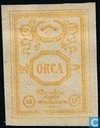
In the autumn of 1918, Russian prisoners of war from the German Empire formed the Northern Corps in Pskov with the aim of retaking Petrograd from the Red Army, but the unit soon had to retreat to Estonia. With British and Estonian support, the Northern Corps led by General Rodzianko advanced again into northwestern Russia in 1919. In the summer of 1919, the Northern Corps was renamed the Northwestern Army under the authority of the new regional government of the Russian Northwestern Oblast in Pskov, led by General Yudenich. This recognized the authority of the Russian state, which was led from Omsk in Siberia by dictator Admiral Kolchak, the so-called Supreme Leader of Russia. Postage stamps were issued (with the inscription "Northwestern Army"), but a few weeks later the capital Pskov was again taken by the Red Army. In the autumn of 1919, the Northwestern Army made a final attempt to capture Petrograd. In the military headquarters at Moloskovitsy, General Rodzjanko printed new stamps (with the inscription OKCA, which stands for “Special Corps of the Northern Army”). The operation failed and before the end of the year the Russian Soviet Republic recaptured all of Northwestern Russia. The Northwestern Army retreated to Estonia, where it was formally disbanded by General Yudenich in early 1920.

Issued in 1919 in Pskov by General Yudenich
Overprint or Russian stamps with the (abbreviated) text Northwestern Army.

Issued in 1919 in Moloskovitsy by General Rodzianko
The issue consists of five imperforate stamps. All stamps bear the Cyrillic inscription OKCA, with differences in stylistic rendering.

South Russia - Kuban People's Republic
Issued in Yekaterinodar (now called Krasnodar).

In Yekaterinodar, anti-communist Cossacks proclaimed the sovereign People's Republic of Kuban within a federal Russian state in early 1918. Shortly afterwards, Yekaterinodar was occupied by the communists, who established the Kuban Soviet Republic. In the summer, the South Russian Volunteer Army under the command of General Denikin, together with the Kuban Cossacks, recaptured Yekaterinodar. From the autumn of 1918, Kuban issued postage stamps. In early 1919, the South Russian Volunteer Army was transformed into the Armed Forces of South Russia, the highest White authority in the south, which confirmed the autonomy of Kuban. From the summer of 1919, the Armed Forces of South Russia themselves recognized the authority of the Supreme Leader of the Russian State in Siberia, namely Admiral Kolchak. At the end of 1919, Kuban broke with the Whites, after which the South Russian Armed Forces of General Denikin himself deposed the Cossack regime of Kuban. In the spring of 1920, Kuban was finally recaptured by the Red Army. The stamps issued by Kuban remained in use until mid-1921.

Russian State - Siberia
Issued at Omsk by Admiral Kolchak.

In Vladivostok, the Whites established the Provisional Siberian Government (VSR). When White forces managed to recapture Omsk from the Red Army in the summer of 1918, they established a rival VSR there, after which the Vladivostok government changed its name to the Provisional Government of Autonomous Siberia (VRAS), while in Samara the Committee of Members of the Constitutional Council (the Komuch) claimed to represent all of Russia. The VRAS cooperated with the Komuch, which after several defeats formed the Provisional Pan-Russian Government (VPRR) with the VSR in Omsk and established the Russian State. After a British-backed coup in late 1918, the VPRR transferred power over the Russian State to Admiral Kolchak, the so-called Supreme Leader of Russia. In the spring of 1919, all Russian White armies recognized the authority of the Supreme Leader, who was internationally regarded as the Russian head of state. In late 1919, the Russian State issued postage stamps. Shortly thereafter, Soviet troops recaptured Western Siberia, including Omsk. The Siberian White armies retreated eastward and Kolchak was executed in early 1920. This marked the end of the Russian State.

Latvia - Western Army (General Bermondt-Avalov)
The Russian Soviet Republic made peace with the German Empire and formally renounced the Baltic States, among others. After the defeat of the German Empire, Latvia, occupied by the Germans, declared independence in the autumn of 1918. Before the end of the year, the Russian Red Army conquered Latvia and the Latvian Soviet Socialist Republic was founded. In the spring of 1919, German paramilitaries and Estonian troops were able to recapture most of Latvia, but after that they fought each other. In the summer of 1919, the Germans had to leave Latvia, but this was circumvented by the establishment of the so-called West Russian Liberation Army, consisting of German paramilitaries and former Russian prisoners of war. Officially, this so-called Western Army, led by General Bermondt-Avalov, recognized the authority of the Supreme Leader of the Russian State and fought against the Red Army, but in practice it mainly defended German interests in the Baltic States. In the occupied territories in western Latvia, the Western Army issued its own stamps. In late 1919, Latvian and Lithuanian troops defeated the West Russian Liberation Army, which was sent back to the German Reich.

Issued in 1919 by Major General Davydov: overprint of Orthodox cross
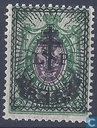
Major General Davydov, as a philatelist, organized the production of the first two issues of the South-Western Army. The first issue is a lithographic overprint of a Russian Orthodox cross on Russian stamps with the Imperial coat of arms in a circle.

Issued in 1919 by Major General Davydov: overprint Orthodox cross with letters 3.A.
The second issue is related to the first but the overprint is extended with the Cyrillic letters 3.A. This is an abbreviation for Western Army in Russian. In addition, the circle is filled with wavy lines.

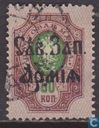
Issued in 1919 by Judge Kuhn: overprint with letters LP and new value
The third issue was provided by Judge Kuhn. It is unclear whether these stamps actually had any connection with the Western Army and were possibly issued by the "Committee of Latvian Self-Government". This would explain the letters LP, Latvijas Parvalde (Latvian Administration). However, this committee is not known in the archives.

_1919 Western Army - Remmer - Imperial Coat of Arms, Perforated, Imperforate
The fourth issue of the Western Army was provided by the head of the political department, A. Remmer. By means of lithography, 9 to 10 million copies were produced at Gotz, Berlin. However, the majority were confiscated by the German police. Only 260,000 stamps were actually delivered to Latvia. A second printing of the issue was published with a better quality. Specialists have not yet reached an agreement whether these stamps are authentic or should be considered forgeries. They have never been in circulation.

Cinderella issues, forgeries and private productions
During the Civil War period, a fair number of Cinderellas and possible forgeries were also produced.

General series
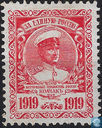
Well known is the general series in the form of the Romanov series , but with images of generals from the White army. All stamps have a clear inscription "1919".
2324

Imprints on the fourth issue of the Western Army
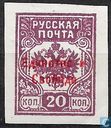
The stamps from the fourth issue of the Western Army were popular with "forgers" to be provided with an overprint.

Stamps with the Russian overprint "Unity and Freedom" were made possible by a White emigrant organization that issued campaign stamps and postcards. They were never intended for postal traffic.

Series commemorating the liberation of Russia
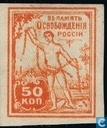
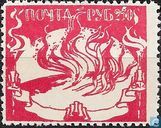
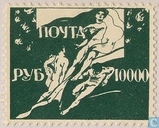
Presumably, a series of three stamps were produced in Berlin in 1919, with the theme of commemorating the liberation of Russia. The images showed a man with a broken chain (50 kopecks), a horn blower (70 kopecks) and a landscape (80 kopecks). These stamps were once attributed to the Western Volunteer Army. Newer insights label these stamps as a Cinderalla issue. The two main reasons are that in 1919 the civil war was still in full swing and that the symbolism of a broken chain was precisely the symbol of the left (the Red Army), to indicate the liberation from tsarism.

United Russia (General Denikin)
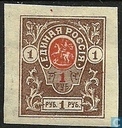
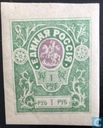
In May 1919, General Deninkin (see South Russia) issued a series of stamps (left image below). In 1920, a similar series appeared with an unknown and most likely unofficial origin (right image). By applying rosettes where the value actually is and by choosing different colours, the aim was possibly to mislead postal officials. The Denikin series was still in use at that time. Other notable aspects are a serious spelling error due to the absence of a dot after PYB and the fact that the frame on all stamps in the series was made with the same printing plate.
Real: Cinderella/counterfeit: 10

Special Detachment of the Belarusian People's Republic
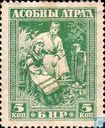
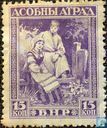
In search of financial resources for the needs of the special detachment of the Belarusian People's Republic in Estonia and the Belarusian mission in the Baltic Sea, a series of stamps was produced in Riga in 1920. These stamps were of a purely speculative nature and were never in postal circulation. The image shows a farmer and his wife and appeared in a series of 5, 10, 15 and 50 kopecks and 1 ruble. The stamps are known both perforated and imperforate and were reprinted several times after 1939, which means that there are several qualities. In the original issue, the 15 kopeck value was slightly different from the rest of the series. In later issues there was no difference.
15 kopecks first edition 15 kopecks reprint/counterfeit

Belarus post
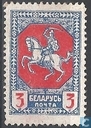
In 1921, a second mock-up issue was produced. It consisted of three stamps with values of 2, 3 and 5 rubles. The 2-ruble stamp showed Francysk Skaryna, a Belarusian humanist from the Middle Ages. The 3-ruble stamp shows the Pahonya coat of arms; this is the coat of arms of Latvia. In 1918, this was also used in Belarus in 1918. The 5-ruble stamp shows a ploughing farmer.

Famine in Odessa toothed imperforate
During the famine in Ukraine, an Italian stamp dealer, Marco Fontano, issued a series of seven stamps in 1922. The images are in Art Nouveau style. Most likely, personal gain was the goal; at the expense of benevolent philatelists. In English, these stamps are known as the "Odessa Famine Relief Issue" and sometimes also as the "Odessa grind" or "Odessa pomgol". The value of these stamps is low today, but low-quality forgeries do exist. These are characterized by smeared colors and incomplete perforations.

Watermarks
Watermarks
Filigrees
Watermarks

F - cf. page d'arrière plan Russie [1857-1917]
E - cf. background page Russia [1857-1917]

Automatic translation Click here for the original text
Hide original text

Inleiding

Rusland is een groot land dat het oosten van Europa en het noorden van Azië omvat. In het voorjaar van 1917, tijdens de 1ste Wereldoorlog, moest de tsaar van het Russische Keizerrijk aftreden ten gevolge van een revolutie en kwam de Voorlopige Regering van Rusland aan de macht. Pas na de zomer werd daadwerkelijk de monarchie afgeschaft en de Russische Republiek uitgeroepen. In het najaar werd de Voorlopige Regering ten val gebracht door een communistische revolutie. Dit was het begin van de Russische Burgeroorlog (1917-1923) tussen het Rode Leger, de Witten en verschillende andere partijen. De communisten controleerden al vlug het grootste deel van Europees Rusland en richtten begin 1918 de Russische Sovjetrepubliek op, die eigen postzegels uitgaf. Vanaf 1919 deden verschillende andere partijen hetzelfde in de gebieden onder hun controle.

Noordwest-Rusland - Noordwestelijk Leger

In het najaar van 1918 vormden Russische krijgsgevangen van het Duitse Rijk in Pskov het Noordelijk Korps met als doel Petrograd te heroveren op het Rode Leger, maar de eenheid moest zich al vlug terugtrekken naar Estland. Met Britse en Estse steun rukte het Noordelijk Korps o.l.v. generaal Rodzjanko in 1919 opnieuw op naar Noordwest-Rusland. In de zomer van 1919 werd het Noordelijk Korps hernoemd tot het Noordwestelijk Leger onder het gezag van de nieuwe regionale Regering van de Russische Noordwestelijke Oblast in Pskov, geleid door generaal Joedenitsj. Deze erkende het gezag van de Russische Staat, die vanuit Omsk in Siberië geleid werd door dictator admiraal Koltsjak, de zgn. Opperste Leider van Rusland. Er werden postzegels uitgegeven (met als opschrift “Noordwestelijk Leger”), maar enkele weken later werd de hoofdstad Pskov opnieuw ingenomen door het Rode Leger. In het najaar van 1919 deed het Noordwestelijk Leger een ultieme poging om Petrograd in te nemen. In het militair hoofdwartier te Moloskovitsy werden door generaal Rodzjanko nieuwe postzegels gedrukt (met als opschrift OKCA wat staat voor “Speciaal Korps van het Noordelijk Leger”). De operatie mislukte en voor het jaareinde heroverde de Russische Sovjetrepubliek geheel Noordwest-Rusland. Het Noordwestelijk Leger trok zich terug naar Estland, waar het begin 1920 door generaal Joedenitsj formeel ontbonden werd.

Uitgifte in 1919 te Pskov door generaal Joedenitsj

Opdruk or Russische zegels met de (afgekorte) tekst Noordwestelijk leger.
Uitgifte in 1919 te Moloskovitsy door generaal Rodzjanko

De uitgifte bestaat uit vijf ongetande zegels. Op alle zegels staat het Cyrillische opschrift OKCA, met verschillen in de stylistisch weergave.
Zuid-Rusland - Volksrepubliek Koeban

Uitgifte te Jekaterinodar (tegenwoordig Krasnodar geheten).

In Jekaterinodar riepen anti-communistische Kozakken begin 1918 de soevereine Volksrepubliek Koeban uit binnen een federale Russische Staat. Niet veel later werd Jekaterinodar bezet door de communisten, die de Koebaanse Sovjetrepubliek oprichtten. In de zomer heroverde het Zuid-Russische Vrijwilligersleger o.l.v. generaal Denikin samen met de Koebaanse Kozakken Jekaterinodar. Vanaf het najaar van 1918 gaf Koeban postzegels uit. Begin 1919 werd het Zuid-Russische Vrijwilligersleger omgevormd tot de Strijdkrachten van Zuid-Rusland, de hoogste Witte autoriteit in het zuiden, die de autonomie van Koeban bevestigden. Vanaf de zomer van 1919 erkenden de Strijdkrachten van Zuid-Rusland zelf het gezag van de Opperste Leider van de Russische Staat in Siberië, nl. admiraal Koltsjak. Eind 1919 brak Koeban met de Witten, waarna de Zuid-Russische Strijdkrachten van generaal Denikin zelf het Kozakkenregime van Koeban afzetten. In het voorjaar van 1920 werd Koeban definitief heroverd door het Rode Leger. De door Koeban uitgegeven postzegels bleven wel nog in gebruik tot midden 1921.

Russische Staat - Siberië

Uitgifte te Omsk door admiraal Koltsjak.

In Vladivostok richtten de Witten de Voorlopige Siberische Regering (VSR) op. Toen in de zomer van 1918 Witte strijdkrachten erin slaagden Omsk te heroveren op het Rode Leger, richtten zij daar een rivaliserende VSR op, waarna de regering te Vladivostok haar naam wijzigde in de Voorlopige Regering van Autonoom Siberië (VRAS), terwijl in Samara het Comité van Leden van de Constitutionele Raad (de Komoetsj) claimde geheel Rusland te vertegenwoordigen. De VRAS werkte samen met de Komoetsj, die na enkele nederlagen samen met de VSR te Omsk de Voorlopige Pan-Russische Regering (VPRR) vormde en de Russische Staat oprichtte. Na een door de Britten gesteunde staatsgreep eind 1918, droeg de VPRR de macht over de Russische Staat over aan admiraal Koltsjak, de zgn. Opperste Leider van Rusland. In het voorjaar van 1919 erkenden alle Russische Witte legers het gezag van de Opperste Leider, die internationaal als het Russische staatshoofd werd beschouwd. Eind 1919 gaf de Russische Staat postzegels uit. Niet veel later heroverden Sovjettroepen West-Siberië, waaronder Omsk. De Siberische Witte legers trokken zich terug naar het oosten en de Koltsjak werd begin 1920 geëxecuteerd. Daarmee kwam een einde aan de Russische Staat.

Letland - Westelijk Leger (generaal Bermondt-Avalov)

De Russische Sovjetrepubliek sloot vrede met het Duitse Rijk en deed daarbij formeel afstand van o.a. de Baltische staten. Na de nederlaag van het Duitse Rijk riep het door de Duitsers bezette Letland in het najaar van 1918 de onafhankelijkheid uit. Nog voor het jaareinde veroverde het Russische Rode Leger Letland en werd de Letse Socialistische Sovjetrepubliek opgericht. In het voorjaar van 1919 konden Duitse paramilitairen en Estse troepen het grootste deel van Letland heroveren, maar daarna streden ze met elkaar. In de zomer van 1919 moesten de Duitsers Letland verlaten, maar dit werd omzeild met de oprichting van het zogenaamde West-Russische Bevrijdingsleger, bestaande uit Duitse paramilitairen en voormalige Russische krijgsgevangenen. Officieel erkende dit zgn. Westelijk Leger o.l.v. generaal Bermondt-Avalov het gezag van de Opperste Leider van de Russische Staat en vocht het tegen het Rode Leger, maar in praktijk verdedigde het vooral de Duitse belangen in de Baltische staten. In de bezette gebieden in het westen van Letland gaf het Westelijk Leger eigen postzegels uit. Eind 1919 versloegen Letse en Litouwse troepen het West-Russische Bevrijdingsleger, dat werd teruggestuurd naar het Duitse Rijk.

Utigifte in 1919 door generaal-majoor Davydov: opdruk Orthodox kruis

Generaal-majoor Davydov organiseerde, als filatelist, de productie van de eerste twee uitgiften van het Zuidwestelijk leger. De eerste uitgifte betreft een opdruk met steendruk van een Russisch Orthodox kruis op Russische postzegels met het keizerlijke wapenschild in een cirkel.

Uitgifte in 1919 door generaal-majoor Davydov: opdruk Orthodox kruis met letters 3.A.

De tweede uitgifte is verwant aan de eerste maar de opdruk is uitgebreid met de Cyrillische letters 3.A. Dit is een afkorting voor Westelijk Leger in het Russisch. Daarnaast is de cirkel gevuld met golflijnen.
Uitgifte in 1919 door rechter Kuhn: opdruk met letters L.P. en nieuwe waarde

De derde uitgifte werd verzorgd door rechter Kuhn. Het is onduidelijk of deze zegels daadwerkelijk een relatie hadden met het Westelijk leger en zijn mogelijk uitgegeven door het "Comité van het Letste zelfbestuur". Dit zou de letters L.P., Latvijas Parvalde (Lets Bestuur), verklaren. Dit comité is echter niet bekend in de archieven.
_1919 Westelijk leger - Remmer - Keizerlijk wapenschild getand ongetand

De vierde uitgifte van het Westelijk leger is verzorgd door het hoofd van de politieke afdeling, A. Remmer. Middels steendruk zijn er 9 a 10 miljoen exemplaren geproduceerd bij Gotz, Berlijn. Het merendeel is echter in beslag genomen door de Duitse politie. Slechts 260.00 postzegels zijn daadwerkelijk geleverd in Letland. Er is van de uitgifte een tweede druk verschenen met een betere kwaliteit. Specialisten hebben nog geen overeenstemming bereikt of deze zegels authentiek zijn of beschouwd moeten worden als vervalsingen. Ze zijn nooit in omloop geweest.
Cinderella uitgiften, vervalsingen en prive-maakwerk

Gedurende de burgeroorlog periode zijn er ook een behoorlijk aantal cinderellas en mogelijke vervalsingen geproduceerd.

Generaal-serie

Bekend is de generaal-serie in de vorm van de Romanov-reeks,maar met afbeeldingen van generaals uit het Witte leger. Alle zegels hebben een duidelijk opschrift "1919".
23 24

Opdrukken op de vierde uitgifte van het Westelijke leger

De zegels uit de vierde uitgifte van het Westelijk leger waren geliefd bij "vervalsers" om voorzien te worden door een opdruk.

Zegels met in het Russisch de opdruk "Eenheid en Vrijheid" zijn mogelijk gemaakt door een emigrantenorganisatie van de Witten die campagnezegels en ansichtkaarten uitgaf. Ze zijn nooit bedoeld voor postaal verkeer.
Serie ter herdenking van de bevrijding van Rusland

Vermoedelijk werd in 1919 in Berlijn een serie van drie zegels geproduceerd, met als onderwerp de herdenking van de bevrijding van Rusland. De afbeeldingen toonden een man met een gebroken ketting (50 kopeken), een hoornblazer (70 kopeken) en een landschap (80 kopeken). Ooit werden deze zegels toegeschreven aan het Westerse vrijwilligersleger. Nieuwere inzichten betitelen deze zegels als een Cinderalla uitgave. De twee belangrijkste redenen zijn dat in 1919 de burgeroorlog nog vol op in gang was en dat de symboliek van een gebroken ketting juist het symbool van links (het Rode leger) was, om de bevrijding van het tsarisme aan te geven.
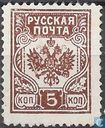
Verenigd Rusland (generaal Denikin)

In mei 1919 heeft generaal Deninkin (zie Zuid-Rusland) een serie postzegels uitgegeven (linker afbeelding hieronder). In 1920 verscheen er een vergelijkbare serie met een onbekende en zeer waarschijnlijk een onofficiële oorsprong (rechter afbeelding). Door het aanbrengen van rozetten op de plaats waar eigenlijk de waarde staat en door het kiezen van andere kleuren, was het doel mogelijk om postbeambten te misleiden. De serie van Denikin was op dat moment namelijk ook nog in gebruik. Verdere opmerkelijke aspecten zijn een ernstige spelfout door het ontbreken van een punt achter PYB en het feit dat het frame op alle zegels uit de serie met dezelfde drukplaat gemaakt is.

Echt: Cinderella/vervalsing: 10

Speciaal detachement van de Wit-Russische Volksrepubliek

Op zoek naar financiële middelen voor de behoeften van het speciale detachment van de Wit-Russische Volksrepubliek in Estland en de Wit-Russische missie in de Oostzee werd in 1920 een serie zegels in Riga geproduceerd. Deze zegels waren van puur speculatieve aard en zijn nooit in postale omloop geweest. De afbeelding toont een boer en boerin en is verschenen in een serie met 5, 10, 15 en 50 kopeken en 1 roebel. De zegels zijn zowel getand als ongetand bekend en na 1939 meermaals herdrukt waardoor er meerdere kwaliteiten bestaan. In de oorspronkelijke uitgave was de 15 kopeke waarde iets afwijkend van de rest van de serie. In latere uitgaven was er geen verschil.

15 kopeke eerste druk 15 kopeke nadruk/namaak
Wit-Rusland post

In 1921 werd een tweede maakwerk uitgifte geproduceerd. Deze bestond uit drie zegels met waarden van 2, 3 en 5 roebel. De zegel van 2 roebel had een afbeelding van Francysk Skaryna, een Wit-Russische humanist uit de middel-eeuwen. De zegel van drie roebel toont het wapen van Pahonya; dit is het wapenschild van Letland. In 1918 werd dit ook gebruikt in Wit-Rusland in 1918. De zegel van 5 roebel toont een ploegende boer.
Hongersnood in Odessa getand ongetand

Tijdens de hongersnood in Oekraïne heeft een Italiaanse postzegelhandelaar, Marco Fontano, een serie van zeven zegels uitgeven in 1922. De afbeeldingen zijn in Art Nouveau stijl. Hoogstwaarschijnlijk was eigen gewin het doel; op kosten van welwillende filatelisten. In het Engels staan deze zegels bekend als de "Odessa Famine Relief Issue" en soms ook als de "Odessa grind" of "Odessa pomgol". De waarde van deze zegels is tegenwoordig laag, toch bestaan er laagwaardige vervalsingen. Deze worden gekenmerkt door uitgesmeerde kleuren en onvolledige perforaties.
Watermerken

Watermarks

Filigranes

Wasserzeichen

F - cfr. page d'arrière-plan Russie [1857-1917]

E - cfr. background page Russia [1857-1917]


Number of stamps
206
Number of related items
0
Oldest item
Don (1918)
Latest item
Kyiv (1922)
Most expensive item
Kharkiv (€ 45.00)
Date of entry:December 22, 2020 17:05by:IgorVdV
Last updated :February 25, 2025 16:52by:Loriot

Russia [1918-1923] - Civil war zones stamp catalogue
  • 1
  • 2
  • 3
  • 4
  • >
206 selected
Occupation of Azerbaijan
  • 1917
  • 10#7
Don
€ 
0
.
50
Don
  • 1918
  • 25#1
don
€ 
3
.
00
don
  • 1919
  • 25#3
Don
Don
  • 1918
Crimean Regional Government
  • 1918
  • 35#1
 Kuban
Kuban
  • 1918
  • 25#1
 Kuban
€ 
1
.
00
Kuban
  • 1918
  • 50#2
Kuban
Kuban
  • 1919
  • 70#1
 Kuban
€ 
2
.
50
Kuban
  • 1918
  • 1#3
kuban
kuban
  • 1918
  • 1#3
 Kuban
€ 
10
.
00
Kuban
  • 1919
  • 25#3
Kuban
€ 
1
.
00
Kuban
  • 1918
  • 25#1
Kuban
€ 
3
.
00
Kuban
  • 1918
  • 25#1
kuban
kuban
  • 1918
  • 50#2
kuban
€ 
0
.
50
kuban
  • 1919
  • 70#5
kuban
kuban
  • 1918
  • 1#3
 Kuban
Kuban
  • 1918
  • 1#3
kuban
kuban
  • 1918
  • 3#4
 Kuban
Kuban
  • 1919
  • 25#3
Don
€ 
2
.
00
Don
  • 1918
  • 25#1
Don
Don
  • 1918
  • 25#2
Don
Don
  • 1918
  • 25#3
don
don
  • 1918
  • 25#4
Don
Don
  • 1918
  • 50#7
Mariupol (Southern Russia)
€ 
20
.
00
Mariupol (Southern Russia)
  • 1919
  • 35#10
Mariupol (Southern Russia)
€ 
40
Mariupol (Southern Russia)
  • 1919
  • 70#50
 United Russia
€ 
0
.
40
United Russia
  • 1919
  • 5
 United Russia
€ 
0
.
40
United Russia
  • 1919
  • 10
 United Russia
€ 
0
.
40
United Russia
  • 1919
  • 15
 United Russia
€ 
0
.
40
United Russia
  • 1919
  • 35
 United Russia
€ 
0
.
40
United Russia
  • 1919
  • 70
 United Russia
United Russia
  • 1919
  • 1
United Russia
United Russia
  • 1919
  • 2
 United Russia
United Russia
  • 1919
  • 3
 United Russia
United Russia
  • 1919
  • 5
 United Russia
United Russia
  • 1919
  • 7
 United Russia
United Russia
  • 1919
  • 10
 United Russia
€ 
21
.
00
United Russia
  • 1919
Northwestern Army
Northwestern Army
  • 1919
  • 2
Northwest Army (General Judenitsch)
€ 
7
.
50
Northwest Army (General Judenitsch)
  • 1919
  • 10#5
Northwestern Army
Northwestern Army
  • 1919
  • 25
 Northwestern Army
Northwestern Army
  • 1919
  • 50
Northwestern Army
Northwestern Army
  • 1919
  • 20
Northwestern Army
Northwestern Army
  • 1919
  • 25
Northwestern Army
Northwestern Army
  • 1919
  • 50
kuban
kuban
  • 1919
  • 70#5
kuban
kuban
  • 1919
  • 10#4
kuban
kuban
  • 1919
  • 10#15
Northwestern Army
€ 
0
.
40
Northwestern Army
  • 1919
  • 5
 Northwestern Army
€ 
0
.
40
Northwestern Army
  • 1919
  • 10
 Northwestern Army
€ 
0
.
40
Northwestern Army
  • 1919
  • 15
Northwestern Army
Northwestern Army
  • 1919
  • 15
 Northwestern Army
€ 
0
.
40
Northwestern Army
  • 1919
  • 20
Northwestern Army
Northwestern Army
  • 1919
  • 20
 Northwestern Army
€ 
0
.
40
Northwestern Army
  • 1919
  • 50
 Northwestern Army
€ 
5
.
00
Northwestern Army
  • 1919
Western Army
€ 
1
.
00
Western Army
  • 1919
  • 5
 Western Army
€ 
0
.
20
Western Army
  • 1919
  • 10
 Western Army
€ 
0
.
40
Western Army
  • 1919
  • 15
Western Army
€ 
0
.
30
Western Army
  • 1919
  • 20
  • Get to know us
  • About LastDodo
  • Catalogue
  • Buy
  • Sell
  • Subscriptions
  • Help
  • How does it work?
  • Frequently Asked Questions
  • Contact
  • Forum
  • Return and refund policy
  • Explore
  • Stamps buy and sell
  • Comic books buy and sell
  • Coins buy and sell
  • Books buy and sell
  • Music buy and sell
  • Film buy and sell
  • Postcards buy and sell
  • Trading cards buy and sell
  • Cigar bands buy and sell
  • Model cars buy and sell
© 2026 LastDodo
Terms of usePrivacy policyCookie policy